


Combining aerodynamic elegance with AI-driven optimization, this minimalist design outperforms similar drones in efficiency, opening new possibilities for low-cost, long-duration aerial missions.
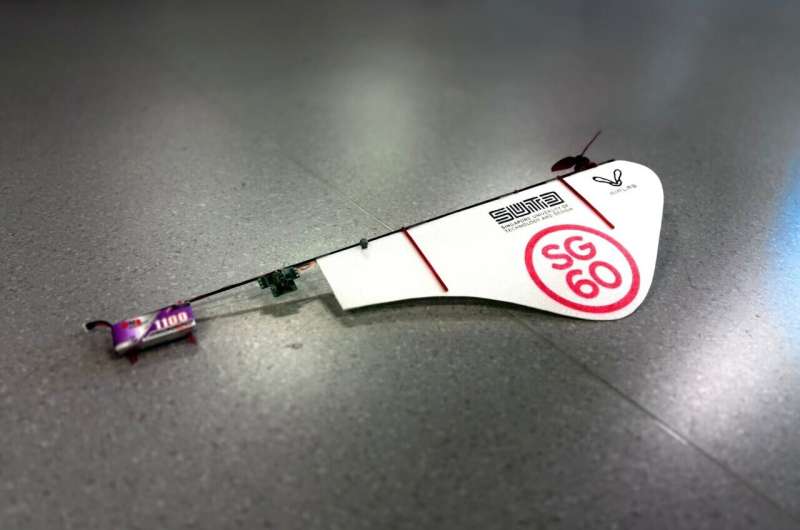
From maple seeds to micro-robots, Singapore University of Technology and Design (SUTD) researchers have achieved a breakthrough in small aerial vehicle efficiency. Led by Associate Professor Foong Shaohui, the team developed a samara-inspired monocopter that delivers 26 minutes of fully controllable hover—exceptional for a 32-gram craft with just one actuator.

Unlike conventional quadcopters, which rely on multiple rotors and complex control systems, this monocopter spins a single winged body, leveraging passive stability and lift—just like spinning maple seeds. Every component contributes to aerodynamic performance, eliminating waste in structure and energy use. The design avoids flapping parts, gearboxes, and linkages, making it mechanically simple yet aerodynamically efficient.
Small drones typically suffer from poor endurance because scaling down reduces propeller efficiency while maintaining high power draw. The SUTD monocopter defies this limitation with a power loading of 9.1 g/W, outperforming hovering-capable micro air vehicles of similar size and weight. This efficiency is the result of combining classical aerodynamic theory with AI-assisted optimization, fine-tuning wing shape, pitching angle, and mass distribution.
The monocopter’s endurance, simplicity, and low manufacturing cost make it ideal for applications such as environmental monitoring, aerial mapping, and lightweight radiosondes for weather data collection. In fact, its radiosonde concept won the Sustainability Award at the James Dyson Award 2024.

This innovation is the culmination of a decade-long journey that began with the SG50 multi-rotor endurance challenge in 2015. Back then, achieving 50 minutes required a large, heavy quadcopter. Today, the SG60 monocopter vision aims for over 60 minutes of flight in a smaller, lighter, and more than twice as power-efficient platform.
Assoc Prof Foong calls it “a reversal of the usual engineering rule,” proving efficiency gains are possible even at smaller scales. The next steps involve developing custom components, increasing payload capacity, and exploring bio-inspired wing morphologies and advanced materials.By fusing human-centered design with AI-driven optimization, SUTD has shown that the future of aerial robotics may be small, simple, and inspired by nature—with the sky truly as the limit.