


The AI chips help devices think faster on their own. Can this make health tools, robots, and home devices work better without the cloud? Read more.
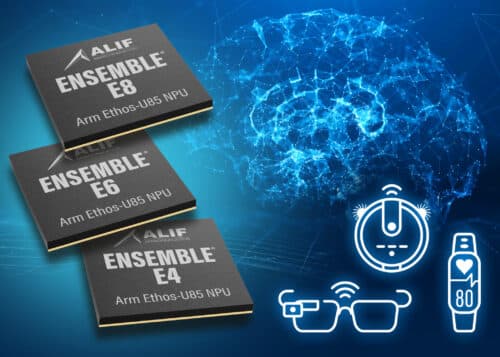
Alif Semiconductor has released benchmark results for its E4, E6, and E8 microcontrollers, reinforcing its position in the AI MCU market. These Ensemble series devices deliver local generative AI capabilities and data processing features.

The E4, E6, and E8 models support up to two MIPI-CSI image sensors and include a hardware-accelerated image signal processor (ISP) pipeline that runs 60fps at 2MP resolution. This is enabled by a wide memory subsystem allowing rapid on-chip and off-chip data transfers, achieving AI inference speeds below one millisecond using low-power internal MRAM.
Alif is the first silicon provider to integrate the Arm Ethos-U85 NPU, designed for transformer-based machine learning. For example, an E4 device running a small language model consumes 36mW while generating text from user prompts.
This blend of efficiency and power opens opportunities for developers to build applications across human-computer interaction, healthcare, robotics, transportation, education, smart homes, and smart cities.
Reza Kazerounian, President of Alif Semiconductor, said: “With the E4, E6 and E8 series of Ensemble GenAI products, Alif continues to push the envelope of edge AI applications. While existing market solutions are built for real-time control, and not for AI, Alif built an AI-ready architecture from the start. That’s why Alif customers are now able to use the E4, E6 and E8 devices to implement transformer-based models and generative AI in edge and endpoint products powered by a small battery.”
Paul Williamson, Senior Vice President and General Manager, IoT Line of Business at Arm, said: “Generative AI is raising the bar for intelligence beyond the cloud, demanding greater performance, privacy, responsiveness, and efficiency. Powered by Arm Ethos technology and supported by our robust software ecosystem, Alif’s latest Ensemble MCUs bring advanced on-device AI capabilities to even the most constrained devices, unlocking real-time insights in applications like health monitoring and wearables. This enables developers to deliver the next generation of intelligent, on-device experiences.”