






These tiny robots talk with sound, fix themselves, and might one day clean the planet or work inside you. Curious how? Read the full story.
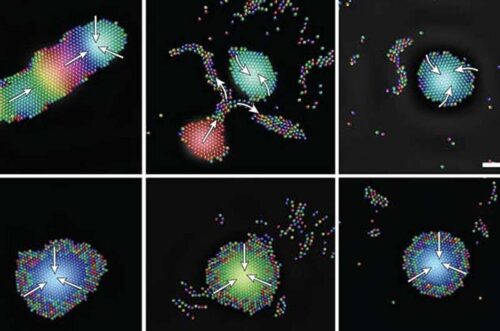
A team of scientists from Penn State has developed tiny robots that use sound waves to work together in large swarms exhibiting smart-like behavior. These robot swarms could one day perform tasks such as exploring disaster zones, cleaning pollution, or delivering medical treatments inside the body.

The miniature microrobot swarms can self-organize by broadcasting sound, allowing them to navigate tight spaces and re-form if deformed. Their collective intelligence helps them detect changes in their surroundings, continue functioning even after breaking apart, and potentially perform threat detection and sensor tasks.
This research advances the development of smarter, more resilient, and practical microrobots with minimal complexity, capable of handling difficult real-world problems. It offers valuable insights for designing the next generation of microrobots that respond to external cues and perform complex tasks in challenging environments.
The study involved creating a computer model simulating tiny robots, each equipped with an acoustic emitter and detector. The model showed that acoustic communication enabled these robots to coordinate and adapt their shapes and behaviors to their environment, similar to schools of fish or flocks of birds.
Although the robots were virtual agents in a theoretical model rather than physical devices, the simulations demonstrated emergent collective intelligence expected to appear in experimental setups with similar designs.
Each simple robot contains a motor, tiny microphone, speaker, and oscillator. They synchronize their oscillators to the swarm’s acoustic frequency and move toward the strongest signal, producing high cohesion and intelligence from minimal components.
This discovery marks a milestone in active matter research—the study of collective behavior in self-propelled microscopic biological and synthetic agents, from bacterial swarms to microrobots. For the first time, sound waves have been shown as an effective means to control micro-sized robots, offering advantages over chemical signaling such as faster, farther propagation with less energy loss and simpler robot design.
Using sound, the robots “hear” and locate each other, leading to collective self-organization. Individually simple, these units combine to form intelligent and functional swarms through basic acoustic communication.
Animals such as bats, whales, and insects have long used sound signals for communication and navigation, inspiring this new approach to microrobot coordination.

