


From consumer wearables, clothing to responsive robots, knitted metasurfaces promise fabrics that shift shape and self-adjust.
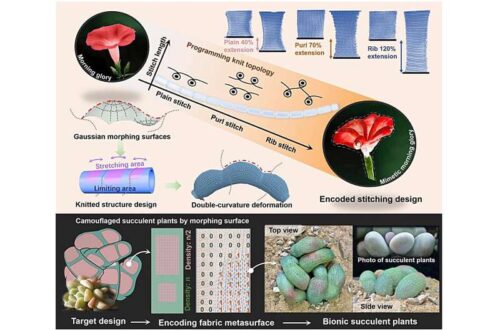
A team of researchers from Jiangnan University, the Technical University of Dresden, Laurentian University, and the Shanghai International Fashion Education Center has created flexible, programmable textile metasurfaces that could enable robots with advanced morphing and camouflage abilities. Published in Advanced Fiber Materials, the innovation relies on knitted structures whose properties are adjusted by precisely altering the geometric pattern of interlaced yarn loops.

Programmable textile metasurfaces promise major benefits for defence, wearable technology, camouflage clothing, adaptive clothing for thermoregulation, wildlife observation, and consumer electronics. Potential users include soldiers requiring dynamic camouflage, wildlife researchers needing responsive skins, urban populations seeking thermoregulating garments, and engineers designing robots capable of navigating confined spaces. These programmable textile metasurfaces could open new possibilities in the field of robotics and electronics, supporting innovations such as smart wearable gear, adaptable consumer devices, and robots with responsive e-skins that can squeeze into narrow spaces, alter shape as per specific environments, and even hide their presence.
The breakthrough enables fabrics to undergo complex deformations, such as inflatable structures with multiple shape modes, single-trigger motion sequences, and flat-to-3D camouflage transformations. This design can deliver scalable, low-cost, and fully customisable solutions. Experimental trials confirmed that by altering stitch arrangements and yarn properties the fabric’s mechanical responses can be directly changed. This method allows the fabric’s mechanical behaviour to be programmed across a wide range of yarn types, offering robust control that remains stable under changing environmental conditions.
Tests showed that the metasurfaces can achieve desirable complex deformations, rarely possible with traditional soft robotics materials, including non-Euclidean morphing, Gaussian curvature-driven transformations, and inflation-induced shape changes. “Our next studies will explore how hierarchical textile structures affect the macromechanics of soft textile robotics, aiming to improve control precision and shape stability. Alongside this, we plan to design and develop wearable shape-morphing camouflage clothing that could be used in real life,” said Dr. Fengxin Sun, senior author of the paper