




Micro-lens enabled cavity arrays let quantum systems read many qubits at once, promising faster computation and integration into quantum networks.
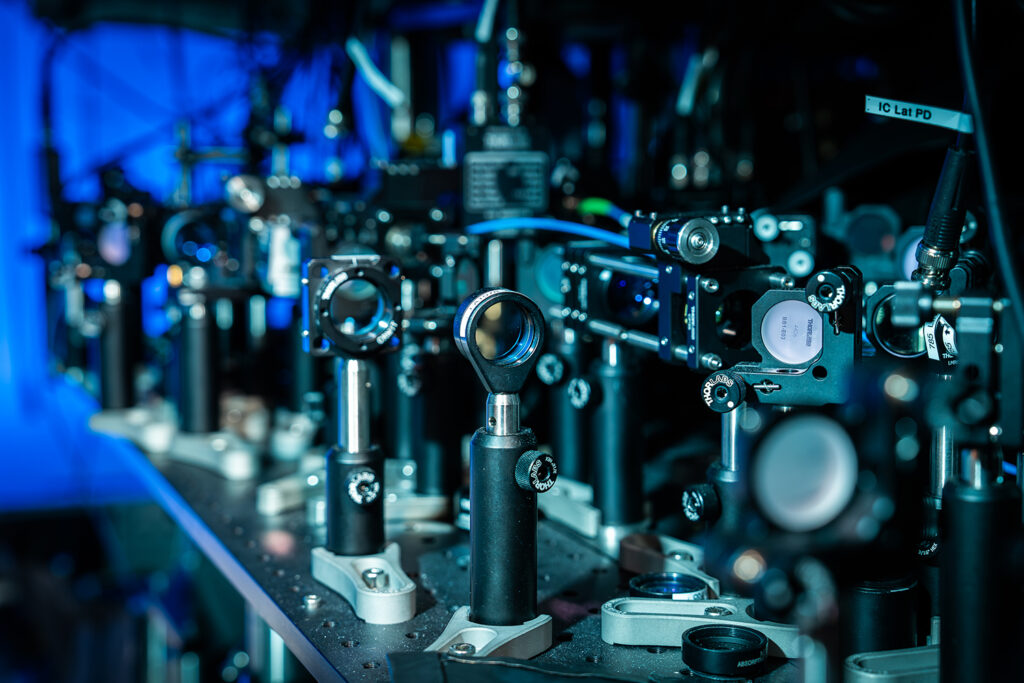
Quantum computers promise to perform complex calculations far faster than conventional systems, but scaling them to millions of qubits remains a critical challenge. Extracting information from qubits efficiently is particularly difficult because atoms emit light slowly and in all directions, limiting readout speed and precision.
Researchers at Stanford University have developed a new optical cavity array that enables rapid, parallel readout of quantum information from atoms acting as qubits. The approach was demonstrated with a 40 cavity array and a prototype exceeding 500 cavities, creating a pathway toward large scale, networked quantum computers.
The team’s design uses micro-lenses within each cavity to focus light tightly on individual atoms. This architecture allows emitted photons to be collected efficiently, effectively creating a “parallel interface” for quantum readout. Unlike conventional chemical doping or complex multiplexing techniques, this method relies on guiding photons from each atom toward a detector, enabling simultaneous access to all qubits.
Key features of the research include:
- Parallel readout of multiple qubits for faster data extraction
- Microlens enabled optical cavities for efficient photon collection
- Scalable design demonstrated with 40 and 500 cavity arrays
- Potential integration into quantum networks and data centers
- Applicability to quantum computing, biosensing, and high resolution microscopy
The research demonstrates a practical method for overcoming a long standing bottleneck in quantum computing, bringing closer the possibility of highly scalable, networked quantum computers capable of tackling problems beyond the reach of classical supercomputers.
Jonathan Simon, senior author and professor of the research, says, “Until now, there hasn’t been a practical way to do that at scale because atoms just don’t emit light fast enough, and on top of that, they spew it out in all directions. An optical cavity can efficiently guide emitted light toward a particular direction, and now we’ve found a way to equip each atom in a quantum computer within its own individual cavity.”


