Tiny 3D devices can now be made from many materials, not just plastic. This method can create micro-robots, sensors, and small machines with new functions.
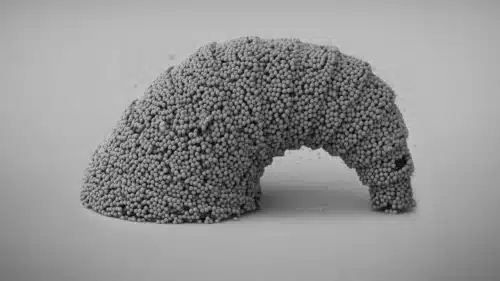
Scientists have found a way to build tiny 3D structures from a much wider range of materials than before. This could solve a major limitation in micro- and nanoscale manufacturing: until now, most high-precision methods only worked with polymers. That restricted what microscopic devices could do in medicine, engineering, and robotics, where metals, semiconductors, or multifunctional materials are often needed.
The new method, developed by researchers at the Max Planck Institute for Intelligent Systems and the National University of Singapore, uses optofluidic assembly to guide particles into precise 3D shapes. Instead of chemically binding materials, it relies on light-driven fluid flow to position microscopic particles inside a prefabricated polymer mold. Once the particles fill the mold, the polymer is removed, leaving a solid object made entirely from the chosen material.
The process works with almost any particle type, allowing researchers to create complex geometries, including cubes, spheres, or even irregular shapes, while retaining mechanical stability. Physical forces like van der Waals interactions hold the structure together, so no chemical bonding is needed.
This approach enables the production of functional microdevices that were previously impossible. Demonstrations include microvalves that sort particles in tiny channels and microrobots that respond to light or magnetic fields. By combining multiple materials and responses in a single device, engineers can design systems with more sophisticated and versatile functions.

The key advance is controlling particle movement using a femtosecond laser. The laser creates localized heating that drives fluid flow, directing particles precisely into the mold. Researchers can control the accumulation of particles and the final shape with high precision.
By freeing microscale fabrication from polymer-only constraints, this technology opens up new possibilities for microrobotics, biomedical devices, and advanced microsystems, allowing engineers and scientists to design structures and devices with materials and functions that were not previously achievable.