




Roadside optical cables act as distributed sensors, with the data used to forecast traffic congestion with higher accuracy.
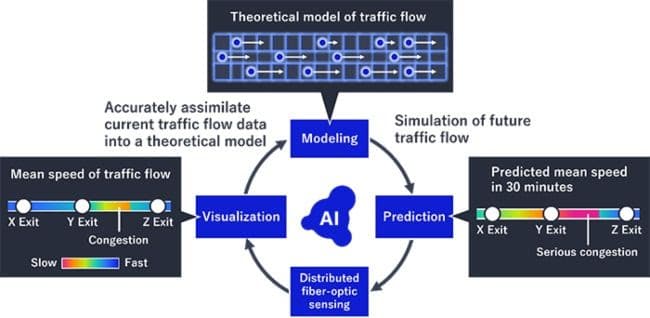
NEC Corporation has announced the development of an optical fiber sensing technology that can monitor road conditions and predict sudden traffic congestion in real time. The system analyses data collected from existing roadside fibre-optic communication cables, combined with a proprietary AI model. According to NEC, prediction errors can be reduced by around 80 per cent compared with current methods.
Conventional monitoring tools rely on cameras, loop detectors or probe vehicle data. These methods provide limited coverage or require costly installation. Existing forecasting models also depend heavily on historical datasets, which makes it difficult to capture unexpected congestion events.
NEC says, using optical fiber lines as distributed sensors and providing continuous coverage of entire routes, the fibres cables will detect changes caused by vehicle movement, allowing real-time traffic flow data to be extracted across wide areas. The data is then processed using NEC’s AI model, which combines two core algorithms.
First, the Model Parameter Optimisation Algorithm, an algorithm that optimise theoretical model parameters, such as driver behaviors (e.g. inter-vehicle distance adjustment) so that simulations reproduce the traffic flow data for entire road segments.
Second, is the Data Adaptation Algorithm, works on the real world data, which converts measurements like average speed and vehicle position into a format compatible with simulation inputs.
Together, these functions allow accurate simulation of traffic evolution under real conditions.
Trial results using road data supplied by Central Nippon Expressway Company showed a marked reduction in travel-time prediction errors compared with cross-sectional data from point sensors. NEC is testing the system with road authorities as part of efforts to establish a digital twin for road networks, with deployment targeted for fiscal 2026.
Findings from the work were presented at the Transportation Research Board Annual Meeting and will be further detailed at the ITS World Congress in Atlanta later this year.
