





By eliminating bulky codebooks and ensuring end-to-end training under noisy channels, the innovation could power next-gen applications from smart factories to AI-driven lifecare systems in the 6G era.
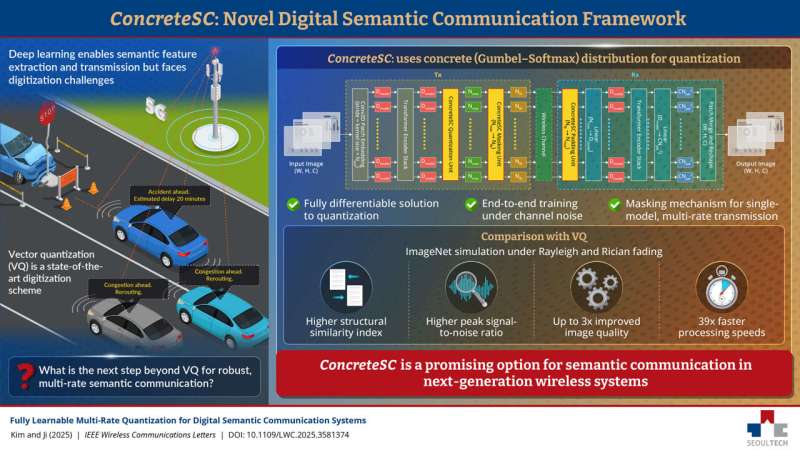
Researchers at Seoul National University of Science and Technology have unveiled ConcreteSC, a next-generation digital semantic communication framework designed to make wireless systems more robust, efficient, and low-overhead. The advancement tackles a critical gap in semantic communications: digitization without excessive computational burden. Unlike traditional vector quantization (VQ), which relies on large codebooks and is vulnerable to noise and codebook divergence, ConcreteSC uses temperature-controlled concrete distributions to generate bitstreams directly. This fully differentiable approach enables smooth end-to-end training even under noisy channel conditions, offering a powerful alternative to existing digitization techniques.
When tested on the ImageNet dataset under Rayleigh and Rician fading scenarios, ConcreteSC consistently outperformed VQ-based baselines in terms of structural similarity index and peak signal-to-noise ratio. Just as importantly, it scales computational complexity linearly with bit length, avoiding the exponential burden of conventional codebooks. This makes it both scalable and adaptable for real-world deployment, while its modular design allows seamless integration into other semantic communication frameworks. According to lead researcher Dr. Dong Jin Ji, associate professor of semiconductor engineering, this innovation has the potential to serve as a key enabler for sixth-generation (6G) wireless systems, where semantic communication will play a central role.
The benefits extend far beyond theory. In smart factories, ConcreteSC could support ultra-dense machine-type communications without relying on physical cabling, enabling greater automation and flexibility. In healthcare and lifecare, low-power IoT devices monitoring seniors and toddlers could run large AI models thanks to the efficiency of semantic communication, improving safety and well-being. By prioritizing meaning over raw data, ConcreteSC delivers improved performance, reduced overhead, and future-ready scalability. As communication systems shift toward AI-driven, meaning-oriented architectures, this innovation represents a critical step in shaping the connectivity backbone of tomorrow’s wireless networks.

