Hanyang University engineers have cracked the stiffness–flexibility trade-off in soft robotics, creating a polymer jumper that can leap 25 times its length and switch seamlessly between vertical and directional jumps—all powered by patterned stiffness and UV light.
Engineers at Hanyang University have harnessed the snap-through effect—a phenomenon familiar in hair clips, retractable pens, and Venus flytraps—to overcome a longstanding trade-off in soft material motion. Their breakthrough, published in Science Advances, demonstrates a polymer-based jumper that achieves both high vertical leaps and precise directional jumps under uniform ultraviolet (UV) light.
Soft robots and actuators often struggle with the balance between stiffness and flexibility. Stiff materials can store energy but resist bending, while softer ones bend easily but release less force. The Hanyang team, led by Professor Jeong Jae (JJ) Wie, solved this by embedding patterns of varying stiffness within a single liquid crystalline polymer film.
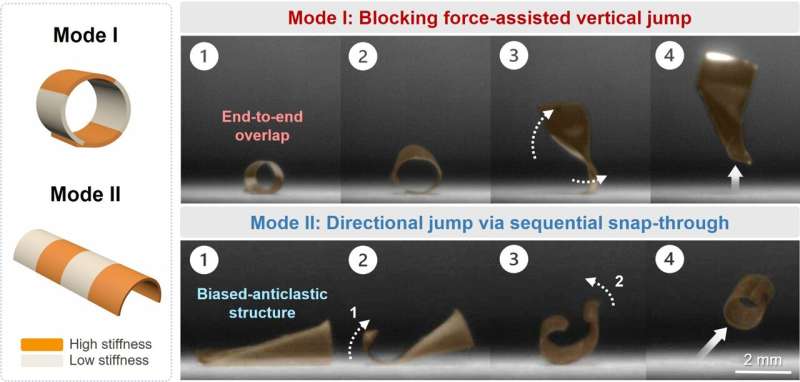
The result: a jumper that uses snap-through transitions—sudden shifts in curvature that rapidly convert stored elastic energy into kinetic force—to achieve record-setting performance. When rigid regions were placed at the center, the device propelled itself vertically up to 49 mm, about 25 times its length. When rigid areas were positioned asymmetrically at the corner, the jumper spun and leapt directionally without needing angled light or external guidance.
The researchers further advanced the design with a “dual-mode” jumper. By extending the film and alternating stiff and soft segments, they enabled rapid switching between vertical and directional motion in a single sequence—a versatility rarely seen in polymer-based soft robots. Depending on how the film deformed, it could either snap upward in a finger-flick-like leap or arch gradually to generate directional travel.
This innovation highlights how principles from biology and bistable mechanics can be engineered into soft materials for amplified performance. Beyond jumping robots, the approach could pave the way for actuators and devices that demand powerful yet precise movement, from biomedical tools to adaptive soft machines.By combining natural inspiration with patterned material design, the Hanyang University team has demonstrated that snap-through mechanics may be the key to solving one of soft robotics’ toughest challenges.