What if textured tandem solar cells could deliver more power? A passivation method cracks the barrier and opens the door to industrial-scale efficiency.
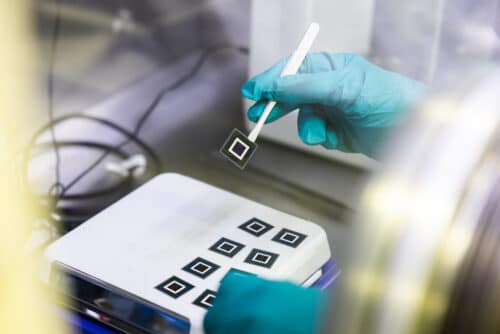
Researchers from King Abdullah University of Science and Technology (KAUST), the University of Freiburg, and the Fraunhofer Institute for Solar Energy Systems ISE have achieved effective passivation of perovskite top cells on textured silicon bottom cells, a major step toward industrializing perovskite-silicon tandem solar technology. The passivated tandem cells reached a conversion efficiency of up to 33.1% with an open-circuit voltage of 2.01 volts.
The breakthrough addresses a long-standing problem. In today’s solar industry, standard silicon cells use textured surfaces with large pyramids to increase light capture and efficiency. While this textured design is ideal for large-scale silicon manufacturing, it has posed challenges for perovskite-silicon tandems. Depositing high-quality perovskite layers on these uneven surfaces was difficult, and effective passivation had previously been achieved only on flat-front tandem cells.
The researchers solved this by applying a specialized chemical treatment that passivates the perovskite layer across the full depth, not just the surface. Unlike in silicon, where passivation improves only the top layers, in perovskite cells the treatment enhances the entire absorber, boosting conductivity, the fill factor, and overall efficiency. This effect was described as a deep field influence that improves bulk properties of the material.
The study details these innovations for perovskite top-cell passivation, showing that textured silicon bottom cells—the industry standard—can be used in tandem structures without compromising performance. Using standard textured silicon aligns with well-established industrial production, simplifying the path to large-scale manufacturing.
Perovskite-silicon tandem cells are widely seen as the next major step in photovoltaics, since conventional silicon cells are nearing their theoretical efficiency limit of 29.4%. By enabling effective passivation on textured silicon, this work lays the foundation for more efficient and stable tandem devices.
Surface passivation is critical for both efficiency and stability. These findings suggest that similar methods can be applied in large-scale production, advancing perovskite-silicon tandem development and building on earlier industrial and research efforts in this field.