




Unexpected “re-entrant” phase behavior in polymer-based solar composites could unlock better efficiency and stability—if scientists update their modeling approaches.
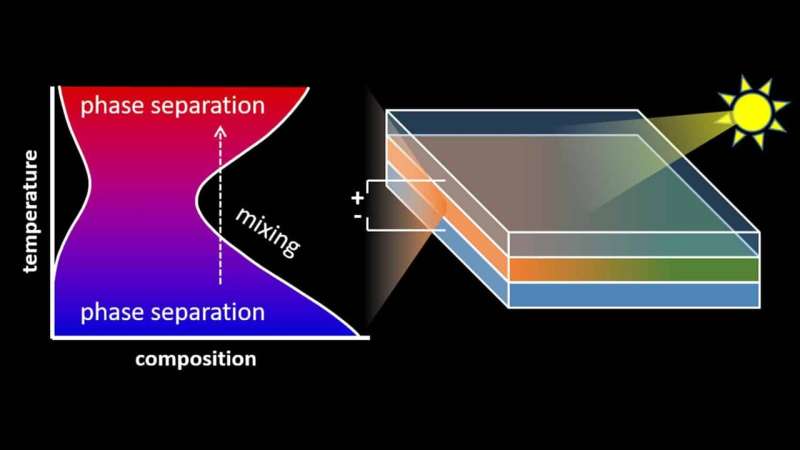
A new study has revealed that organic solar cells behave far more unpredictably than previously thought, showing a “re-entrant” mixing phenomenon that challenges classical polymer science. This insight could open new possibilities for designing more efficient and longer-lasting solar energy materials.
Researchers from North Carolina State University, the Max Planck Institute for Polymer Research, and international collaborators created phase diagrams of more than 50 polymer–small molecule acceptor (SMA) composites, the building blocks of organic solar cells. These diagrams, which are critical for predicting device stability and performance, showed that nearly half of the blends defied expectations. Instead of mixing more easily at higher temperatures—as most materials do—they separate when heated and re-mixed when cooled, displaying a counterintuitive “re-entrant” behavior.
Unlike conventional commodity polymers with predictable thermal behavior, polymer:SMA composites are governed by additional molecular complexity, making their phase transitions more intricate than traditional models can explain. By focusing on parameters such as free volume—the way molecules expand or contract with heat—and the glass transition temperature, when materials freeze into a non-crystalline solid, the researchers developed a more complete framework to interpret these transitions. Including these factors in models appears to qualitatively reproduce the experimental results.
This deeper understanding of mixing behavior has significant implications. It could guide the design of organic solar cells with higher power-conversion efficiency and greater stability, key to scaling renewable energy technologies. “Polymer:SMA blends offer high solar cell efficiency and stability, but only if their mixing behavior is precisely tuned,” explains Harald Ade, Distinguished Professor at NC State. Jasper Michels of the Max Planck Institute adds that extending models to include the glass transition and other parameters is essential to capture the complexity of organic semiconductors.
Ultimately, the work underscores that advancing solar cell performance will require rethinking the physics of organic materials. Efficiency and stability depend on molecular interactions at much smaller scales than we used to account for.


