




High-voltage circuits need strong, reliable capacitors. TDK claims that the low-resistance capacitors stay stable under stress, save space, and make devices work better.
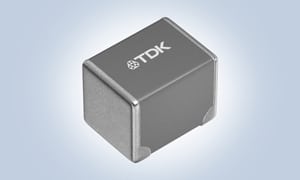
High-voltage resonance applications, such as LLC resonant circuits and wireless charging, increasingly require large resonance capacitance. As these applications grow more powerful, they need high-voltage, large-volume capacitors that are both reliable and low-loss. Conventional capacitors with resin electrodes are used to prevent placement cracks caused by external stress, but higher resistance in these electrodes has been a persistent issue, limiting performance.
TDK Corporation has addressed this challenge with the expansion of its CN series of low-resistance soft-termination MLCCs. By optimizing the resin electrode structure, the CN series significantly reduces resistance while maintaining the reliability benefits of resin electrodes. The new capacitors achieve an industry-leading 22 nF capacitance in the 3225 case size with stable C0G characteristics at 1000 V, making them well-suited for use as resonator and snubber capacitors. The main applications of these capacitors include resonance circuits and snubber circuits, where stable performance under high voltage and stress is critical.
Along with low losses and capacitance stability over temperature and voltage variations, the optimized resin electrodes provide both high reliability against external stress and reduced loss. By combining product and process design optimization, TDK has made it possible to manufacture these capacitors with enhanced reliability for high-voltage circuits, improving the overall reliability of end applications.
The company’s unique terminal structure enables soft termination MLCCs whose low resistance matches that of standard terminal products. Combined with C0G characteristics, these capacitors offer low loss and stable capacitance across temperature and voltage variations. The use of resin electrodes allows for higher reliability in applications, reduces the component count, and supports miniaturization, even in high-voltage, large-volume designs.
