





The brain-inspired components integrate storage and processing, achieving over 93% accuracy in simulations—offering a path to energy-efficient neuromorphic chips compatible with today’s semiconductor technology.
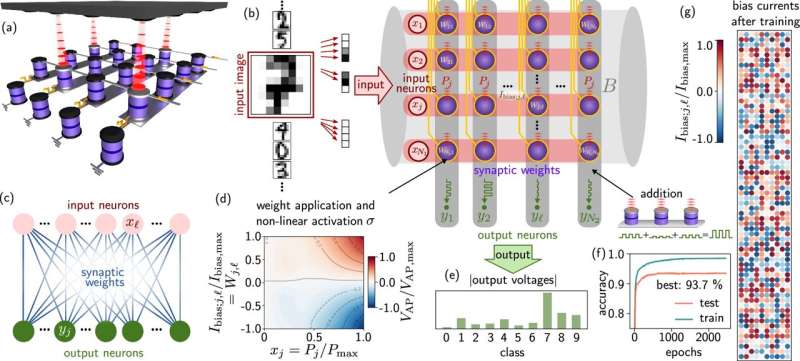
Neuromorphic computing may have just gained a crucial boost. Researchers from the University of Greifswald, working with teams in Portugal, Denmark, and Germany, have demonstrated how magnetic tunnel junctions (MTJs) can mimic brain-like synaptic behavior—paving the way for compact, energy-saving chips for future AI systems.
The breakthrough, reported in Communications Physics, centers on a hybrid opto-electrical excitation scheme that uses both electrical currents and ultrafast laser pulses. This method generates unusually high thermoelectric voltages within MTJs, a key requirement for reproducing how biological synapses process and transmit information.
Three features stood out. First, the voltage could be tuned flexibly by adjusting electrical current, mimicking synaptic weights that determine learning strength in the brain. Second, spontaneous “spike” signals appeared—an echo of how neurons communicate via rapid electrical bursts. Third, when modeled in a simple neuromorphic network, the system achieved 93.7% accuracy in recognizing handwritten digits, highlighting its potential for machine learning tasks.
Traditional silicon processors struggle with AI’s escalating demands, consuming vast energy while separating storage from computation. Neuromorphic systems promise to overcome this bottleneck by tightly integrating memory and processing, much like biological brains. The Greifswald-led study suggests MTJs could deliver this leap without abandoning existing semiconductor ecosystems.
While quantum computing often dominates headlines as the heir to classical silicon, spintronic MTJ-based designs are emerging as a complementary track. Their low-energy footprint and brain-inspired operation could help scale AI models without overwhelming power grids. If realized commercially, neuromorphic chips powered by MTJs might bring AI closer to the brain’s legendary efficiency—performing massive data tasks with minimal energy, and shrinking the gap between human cognition and machine intelligence.
“These components don’t just store data, they also process it,” said Dr. Tahereh Sadat Parvini, a postdoctoral researcher at Greifswald. “That duality makes them ideal for neuromorphic architectures.” Prof. Markus Münzenberg, co-lead author, added that compatibility with today’s chip technology makes MTJs especially attractive. “We see a clear pathway from fundamental physics to practical devices—whether in everyday electronics or high-performance computing.”


