Researchers at Waseda University have developed sulfur-based polymers with ultralow dielectric loss, offering a major leap toward faster, more efficient 6G and high-frequency communication technologies.
As 6G telecommunications move closer to reality, the need for materials that can sustain ultra-high-frequency signals with minimal loss has become critical. A team at Waseda University, Japan, has now developed a new class of polymers that could revolutionize high-frequency communication materials—achieving unprecedentedly low dielectric losses at gigahertz frequencies.

The research, led by Professor Kenichi Oyaizu from Waseda’s Department of Applied Chemistry, introduces poly(phenylene sulfide) (PPS) derivatives that overcome the long-standing trade-off between a low dielectric constant (Dk) and a low dissipation factor (Df)—key metrics determining signal efficiency. Their study demonstrates how substituting oxygen with sulfur atoms in polymer structures can dramatically reduce dielectric loss.
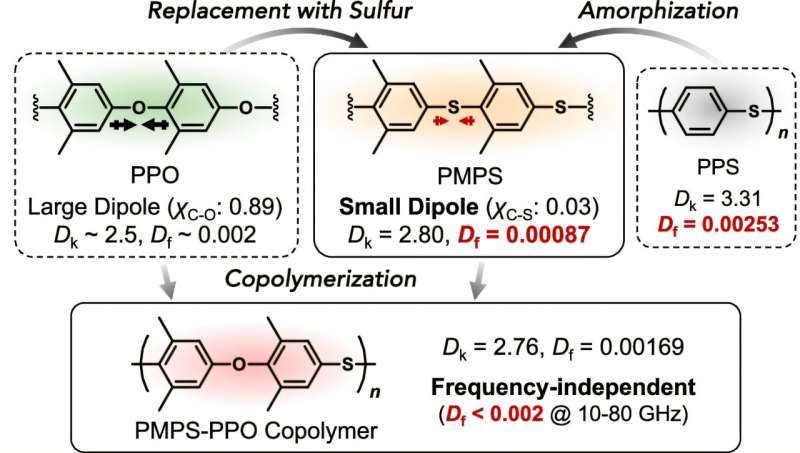
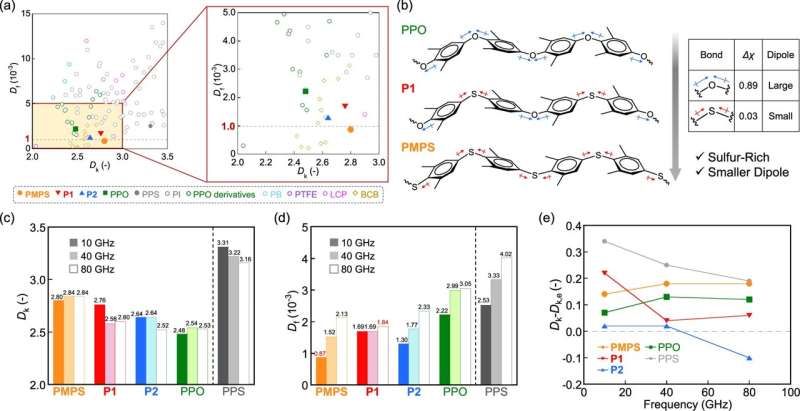
Conventional materials such as poly(2,6-dimethyl-1,4-phenylene oxide) (PPO) perform well in balancing Dk and Df but struggle at higher frequencies. By replacing oxygen with sulfur to create poly(2,6-dimethyl-1,4-phenylene sulfide) (PMPS), the Waseda team achieved an ultralow Df of 0.00087 and a Dk of 2.80 at 10 GHz—far outperforming PPO. This improvement stems from the carbon–sulfur bond’s smaller dipole moment and higher polarizability, leading to lower energy loss during signal transmission.
Two copolymers, labeled P1 and P2, were also synthesized with alternating oxygen-sulfur sequences. These materials maintained low dielectric constants (2.64–2.76) and stable dissipation factors, with P1 notably retaining a nearly constant Df even at 80 GHz. The reduced molecular motion and enhanced intermolecular interactions in P1 contribute to this stability, making it highly suitable for future high-frequency insulating applications.
According to Oyaizu, the team’s “oxygen-to-sulfur substitution strategy” marks a breakthrough in polymer design, potentially enabling low-loss, thermally stable materials vital for next-generation 6G networks, advanced radar, and high-speed computing systems.