Measuring skin temperature in wearables is hard. This reference design shows how to get readings using sensor placement, signal paths, and small boards.
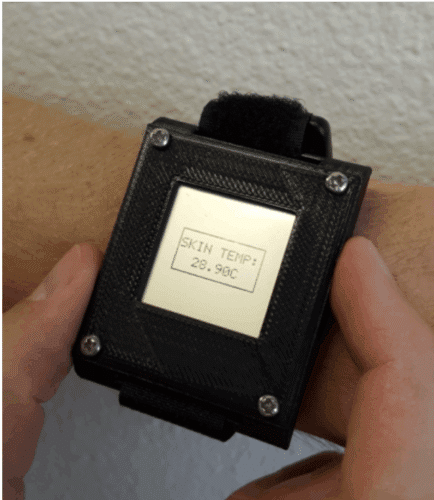
Wearable devices that measure human skin temperature face multiple design challenges. Engineers must ensure good thermal contact between the sensor and skin, maintain signal path integrity for accurate readings, and fit the system into a compact, low-power form factor. Fast thermal response and sub-degree accuracy are critical for devices like smartwatches and fitness trackers. The system also needs to handle both skin and ambient temperature measurements without interference while integrating with microcontrollers and display systems.
The TIDA-00824 reference design from Texas Instruments addresses these challenges. It demonstrates a complete wearable temperature measurement solution using two LMT70 analog temperature sensors—one for skin and one for ambient or board temperature. The sensors connect to an analog-to-digital converter (ADC), which digitizes the signals and sends the data via I2C to the microcontroller for processing.
This design provides detailed guidance on mechanical mounting of the LMT70 sensors, thermal path routing, and selection of ideal signal path components. It helps engineers achieve measurement accuracy better than 0.1°C within the human body range of 20°C–42°C.
The system uses two PCBs to balance size and performance. The main PCB hosts the battery, LCD connector, ADC, and microcontroller. The remote PCB contains only the LMT70 sensor and thermal components such as copper pads and thermal vias. Both boards are connected through the J2 connector. Placing the skin sensor close to the heat source ensures faster thermal response.

The remote PCB is very small and includes thermal copper pads on the underside that conduct heat to the analog temperature sensors die through thermal vias. This ensures accurate and fast skin temperature measurements. The main PCB handles power, signal conversion, and display functions, including enabling the system, triggering measurements, and showing readings on the LCD.
The analog temperature sensor offers 0.05°C typical accuracy in the 20°C–42°C range and 0.36°C maximum over -55°C–150°C. Its tiny WLCSP package (0.88mm × 0.88mm), low current consumption, and wide voltage range make it ideal for compact, low-power wearable systems.
The ADC provides 16-bit sigma-delta conversion, four single channels or two differential channels, an internal voltage reference, oscillator, multiplexer, and programmable gain amplifier (PGA). Firmware can be updated using the SPI-by-wire connector, which keeps the pin count low and the footprint small.
By combining precise mechanical design with a well-managed signal path, TIDA-00824 shows how engineers can build a compact, high-accuracy wearable temperature measurement system that balances thermal performance, electrical precision, and low power, making it suitable for real-world wearable applications.
TI has tested this reference design. It comes with a bill of materials (BOM), schematics, assembly drawing, printed circuit board (PCB) layout, and more. The company’s website has additional data about the reference design. To read more about this reference design, click here.