





Using friction shock absorbers and reverse thrust, the experimental quadcopter achieves stable touchdowns in motion—paving the way for drone deliveries to ships, emergency vehicles, and other mobile platforms.
Drones are now a familiar part of modern skies, used in everything from aerial photography and surveillance to agriculture and logistics. Yet, one of their biggest weaknesses remains landing — a phase responsible for nearly half of all drone accidents. Touching down on moving or uneven surfaces poses significant challenges, particularly when high winds or motion are involved. Now, researchers at the University of Sherbrooke in Canada have developed a friction-based landing system that allows drones to safely land on fast-moving vehicles, potentially transforming how autonomous aerial systems operate in dynamic environments.
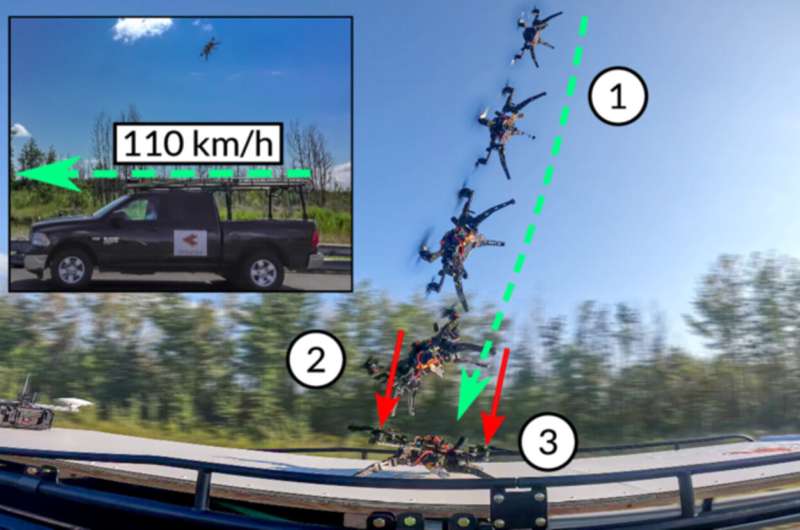
Landing on a moving platform is difficult because drones must pitch sharply forward to counter air drag, which risks damaging the propellers upon contact. Conventional landing gear, being rigid, often causes drones to bounce or flip on impact. To solve this, the Sherbrooke team built an experimental quadcopter called DART (Direct Approach Rapid Touchdown), which uses friction shock absorbers (FSAs) and reverse thrust (RVT) to achieve stable landings even at high speeds.
The DART system works by executing a rapid, aggressive descent to minimize exposure to wind turbulence. Just before impact, it performs a leveling maneuver to align horizontally with the moving surface. On touchdown, the FSAs absorb the impact’s kinetic energy while the motors engage reverse thrust, pressing the drone firmly onto the vehicle to prevent slipping or rebounding. This combination ensures that the drone remains stable, even on vehicles traveling at speeds up to 110 km/h (68 mph).
The team achieved 38 consecutive successful landings on a pickup truck traveling at high speed. The use of FSAs with RVT expanded the drone’s safe operating envelope by a factor of 38 compared to standard gear, giving it greater control during pitch-leveling maneuvers under various flight conditions.
This innovation could open new frontiers for drone applications — from landing on moving boats, ships, and emergency vehicles to conducting operations in harsh weather or unstable terrain. By blending mechanical innovation with intelligent flight control, the DART system marks a major step toward more autonomous, reliable, and mobile drone missions.
