




Smart locks can quickly drain batteries. The design shows how engineers can make them last longer using low-power electronics and efficient wireless control.
Wireless battery-powered smart locks are increasingly popular as more building owners and homeowners retrofit doors with electronic locks. These systems face a key design challenge: balancing functionality with battery life. High-current motors and radios can quickly drain batteries, and replacing multiple batteries is time-consuming and costly. Lowering average current consumption is therefore a primary design consideration. Applications for these designs extend beyond smart locks to include door keypads and readers, building automation, security systems, and HVAC valve and actuator control. Understanding how to manage power across these applications is critical for engineers developing low-power solutions.
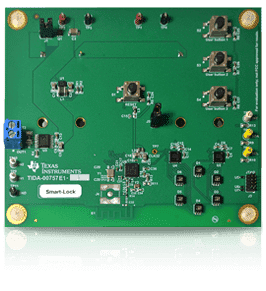
The TIDA-00757, is the reference design from Texas Instruments (TI) demonstrates how engineers can extend battery life using a highly efficient power topology. It leverages a SimpleLink ultra-low-power wireless MCU platform with an integrated Bluetooth Low Energy (BLE) radio, motor driver, and RGB LED driver. A DC/DC converter provides light-load efficiency, minimizing standby current and extending off-state intervals. The guide includes component selection, design theory, and test results from the TI Design system, giving engineers practical insight into implementing low-power designs for electronic locks, door keypads, wireless automatic blinds, and HVAC dampers and actuators.
The design allows the MCU with integrated BLE radio to wirelessly lock and unlock a door while monitoring battery voltage for low-life indication. It limits motor current to extend motor life and communicates events to the user via LED lighting and patterns. Engineers can calculate average power consumption per device and estimate battery life in mW-hours by focusing on the four main devices in any smart lock, which are the MCU, Bluetooth radio, motor driver, and power management. In this design, the MCU combines the MCU and Bluetooth radio, simplifying the analysis to three devices.
Two operational scenarios are analyzed. The first scenario considers periodic BLE connection events, typically every 500 milliseconds or a user-defined interval, which represent regular wireless communication with minimal current. The second scenario involves lock or unlock events that drive roughly 1 A through the DC motor, where motor current is nearly two orders of magnitude higher than BLE current. Time when the BLE radio is paired is ignored, as it precedes events and has minimal impact on average power consumption. By applying device-level power equations to these scenarios, engineers can predict battery life and optimize system parameters for long-term operation.
This design provides a practical framework for engineers seeking to balance wireless functionality, motor performance, and long battery life in smart lock systems and related battery-powered applications.
TI has tested this reference design. It comes with a bill of materials (BOM), schematics, assembly drawing, printed circuit board (PCB) layout, and more. The company’s website has additional data about the reference design. To read more about this reference design, click here.