In wireless product development, how do you select the right communication technologies, from identifying the specific hardware and software to delivering the finished product?
How do you define a successful product? There are technologically great products that fail to compete in the market. Why? Because those technologies do not understand the pulse of the market. Some product failures can be avoided by better design and through extensive testing.
The key is to identify the problem first and then narrow it down to the technology that can address it.
Table of Contents
Product Development Stage 1: Component Selection
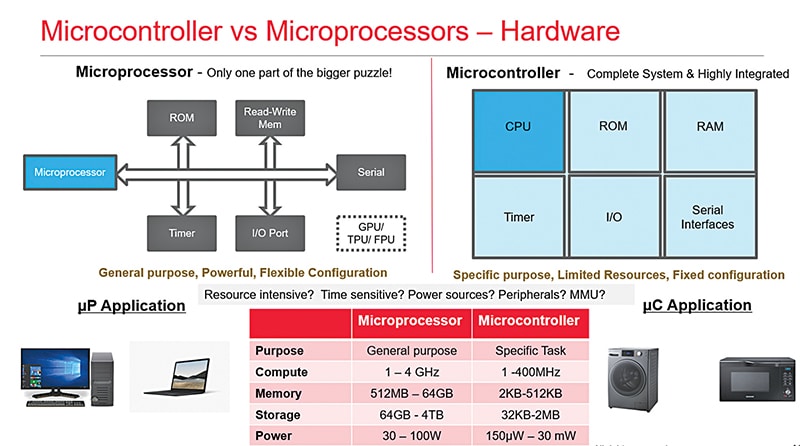
The first critical decision in embedded product design is selecting the right processing unit: the right microprocessor unit (MPU) or the right microcontroller unit (MCU).
MPUs, commonly found in laptops and general-purpose systems, offer high flexibility and performance but require external elements, such as RAM, ROM, and storage, to achieve full system functionality. These systems are highly flexible for parallel processing of multiple threads. The computing speed is significantly higher than that of MCUs, thanks to their built-in memory management units, which facilitate memory address translation for hosting operating systems like Linux or Windows.
MCUs, or microcontroller units, are highly integrated. Everything is packed into a single chip. They are built for dedicated tasks with real-time constraints, offering predictable, low-latency performance. For applications such as automotive airbags, where every millisecond counts, MCUs paired with real-time operating systems are essential. The choice ultimately hinges on resource demands, timing sensitivity, and system complexity.
Check the comparison between Microcontroller and Microprocessor.
Stage 2: Selecting the Right Wireless Technology
After selecting the required MPU or MCU, choosing the right wireless technology remains one of the trickier calls, as there is a plethora of options in embedded system design.
When choosing, three primary factors matter: range, data rate, and power constraints. The required transmission distance, the volume and speed of data, and whether the device is battery-operated or powered by the mains are all fundamental considerations.
Beyond these, additional factors include licensed versus unlicensed spectrum, network topology, and localisation accuracy or proximity-based applications, which are vital for asset tracking.
For instance, low-power wide area networks, capable of transmitting tiny amounts of data over long distances, are helpful for remote IoT deployments and can run on a battery.
In contrast, short-range technologies like Wi-Fi and Bluetooth, often found in smartphones and consumer devices, deliver higher data rates but are limited in range and are more power-hungry, falling under what is termed a personal area network.
The Wireless Buffet: System-on-chip
The starting point for wireless product integration often begins with a system-on-chip (SoC), which integrates the wireless transceiver, memory, and sometimes a GPU and NPU into a single block. SoCs can be derived from either microcontrollers or microprocessors and are particularly advantageous in space-constrained designs.
The key trade-off here is efficiency versus flexibility. SoCs offer streamlined integration and power efficiency but limit customisation.
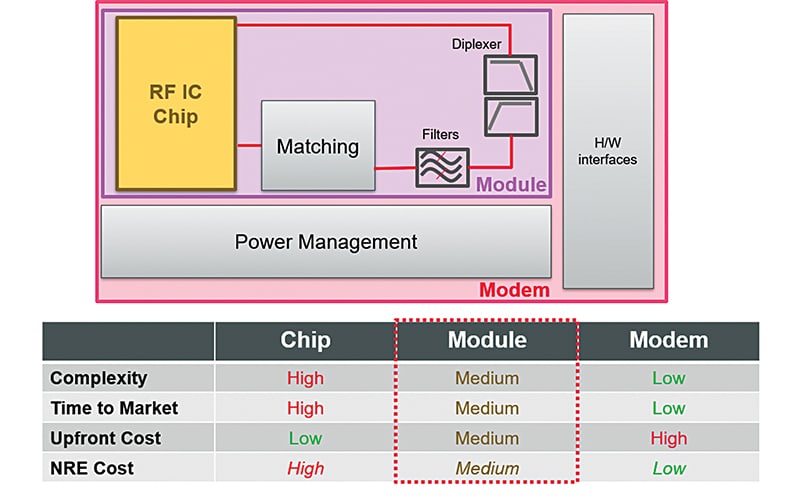
For applications demanding more flexibility, designers may turn to external wireless companion chips. These allow the MCU or MPU to be paired with a discrete wireless module. Some options are:
- RF ICs (radio frequency integrated circuits) offer raw radio functionality but require custom front-end design for matching, filtering, and antenna integration. RF ICs cannot be directly used on any PCB and therefore need proper front-end design.
- Modules simplify integration by embedding both the RF IC and the required front-end circuitry. These are ideal for mid-volume production, balancing design control with ease of use.
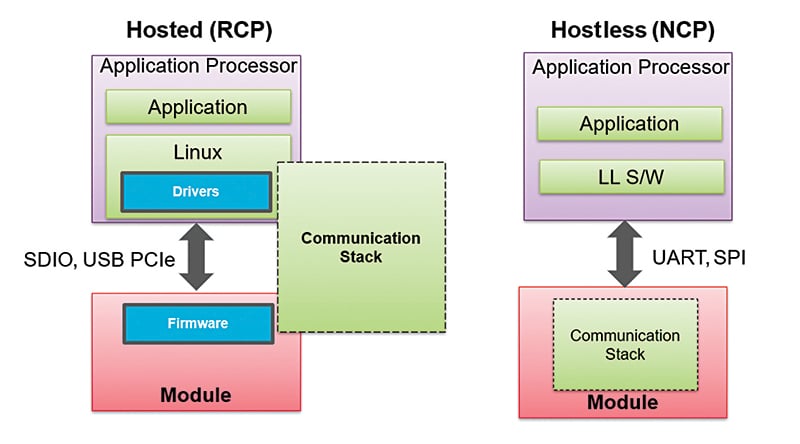
Host vs Hostless Architecture