




A new method could make perovskite solar cells last longer and work better using special liquids. Could this be the key to more reliable solar power?
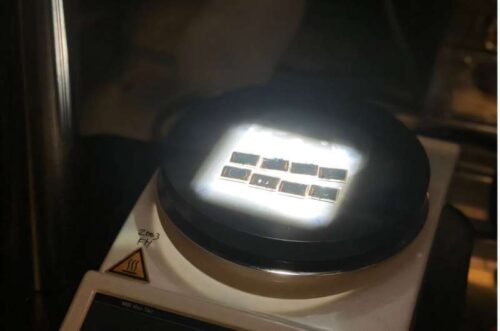
Solar cells convert sunlight into electricity and help reduce fossil fuel use, but engineers are now exploring alternatives to silicon to improve efficiency, durability, and cost. Halide perovskites absorb light well and transport charge efficiently, enabling high power conversion efficiency. However, compared to silicon, they are much less stable and their performance degrades quickly over time.
Researchers from Purdue University, Emory University, and other institutes have proposed a new way to improve the working stability of these solar cells. Their study shows that adding specially designed ionic liquids, salts that stay liquid at low temperatures and interact strongly with materials, can help make halide perovskite solar cells more stable.
The research team works on organic synthesis, perovskite crystal growth, and device engineering. An industry partner asked them to develop new additives to improve the long-term stability of perovskite solar cells. A review of earlier studies showed that most used simple, off-the-shelf ionic liquids without detailed molecular design, which led the team to create new ionic liquids tailored specifically for perovskite materials.
Building on prior research, the team designed new molecules that interact strongly with perovskites, reducing defects and slowing degradation. Perovskite solar cells typically consist of an active layer placed between two interface layers, where defects can form both inside the material and at the interfaces. Unlike earlier efforts that mainly focused on the top interface, this work also addressed defects in the bulk material and at the buried bottom interface. One ionic liquid showed strong binding with lead ions and filled missing halide sites, improving crystal growth and reducing defects.
Solar cells made using this approach were tested under harsh conditions, including high temperatures and continuous full sunlight. Even at 90°C, the devices retained about 90% of their initial performance after more than 1,500 hours. The results show that carefully designed ionic liquids can greatly improve stability while remaining easy to synthesize and suitable for large-scale manufacturing. The method also works for wide-bandgap and lead-free perovskites, supporting future tandem solar cell designs and broader commercial adoption.


