

Switching fans to BLDC motors can be tricky. This reference design shows an easy, complete way to control them, save energy, and work with any voltage.
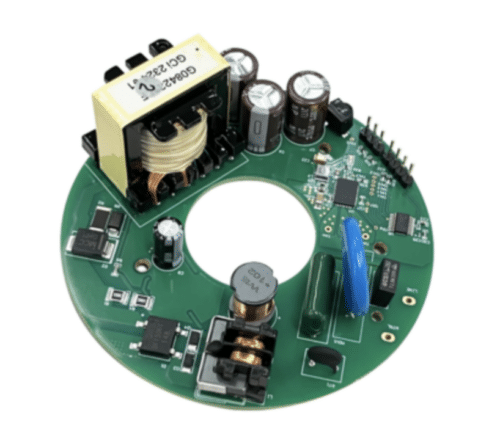
Design engineers moving ceiling and ventilation fans from AC induction motors to brushless DC (BLDC) motors face challenges in energy efficiency, universal voltage operation, compact design, and motor control. TIDA-010951, a reference design from Texas Instruments (TI) addresses these needs by providing a complete solution that integrates AC-DC conversion, power factor correction (PFC), and sensorless field-oriented control (FOC) for BLDC motors. It supports a wide range of applications including air purifiers, humidifiers, residential and living fans, dishwashers, washers and dryers, and various appliance pumps and fans.
BLDC motors are preferred for applications requiring wide speed control because they are more efficient than induction motors. Low-voltage BLDC motors provide additional benefits for low-power applications, including operation across universal voltage inputs, reduced motor and passive component costs, and compact PCB designs. However, these motors still require an efficient and cost-effective AC-DC conversion stage. This reference design addresses this with a simple, integrated solution.
The design integrates a buck PFC stage with a feature-rich motor controller. The PFC stage converts universal AC input to a regulated 24 V DC output, achieving a high power factor. This 24 V DC powers a three-phase sensorless FOC BLDC motor controller, which drives the motor, maintains speed under varying loads, and generates a low-voltage supply for the MCU.
Motor speed is controlled via PWM signals from low-cost, general-purpose MCUs, based on input from an infrared sensor activated by a standard IR remote. The firmware can be easily customized to support different remote control formats, providing flexible operation across applications. I²C communication with the motor driver allows configuration and monitoring, while GPIO pins handle brake, speed feedback, speed input, and drive-off functions.

The BLDC motor controller is a fully integrated, protected single-chip solution combining sensorless FOC algorithm, gate driver, and FETs. It ensures precise speed control and simplifies board design. The MCU runs at high speed with sufficient flash and RAM and is compatible with multiple variants, offering flexibility in component selection.
The PFC controller manages low- to medium-power applications requiring power factor correction and EMC compliance. It can drive flyback, buck, or boost converters in critical conduction mode. The controller includes a transconductance voltage amplifier for feedback error processing, a simple current reference generator, a current-sense PWM comparator, PWM logic, and a totem-pole driver to drive an external FET.
The BLDC motor driver features integrated sensorless, code-free FOC and a 3-phase inverter power stage, providing a compact, efficient, all-in-one solution for applications such as residential fans, appliance pumps, seat cooling blowers, and projector fans.
This reference design provides a complete, compact solution for engineers, combining high-efficiency AC-DC conversion, protected motor control, flexible MCU integration, and compatibility with low-voltage BLDC motors to simplify development and accelerate time-to-market for a wide range of home and industrial appliance applications.
TI has tested this reference design. It comes with a bill of materials (BOM), schematics, assembly drawing, printed circuit board (PCB) layout, and more. The company’s website has additional data about the reference design. To read more about this reference design, click here.