





Want to add CAN or LIN to 5V systems easily? Check out these MCUs that handle networking, sensing, and control without extra parts.
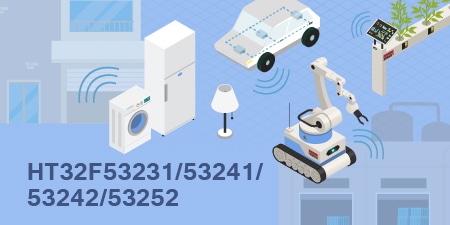
Many embedded designers struggle to add CAN networking to systems that run on 5V rails. This is common in industrial controls, building systems, and vehicle electronics, where 5V sensors, actuators, and existing designs are still used. Holtek’s HT32 Cortex-M0+ MCUs are built for this gap.
The HT32F53231/241/242/252 devices are for engineers who need to build CAN networks without external level shifting or added power design steps. The built-in Bosch-licensed CAN controller supports CAN 2.0A and 2.0B and meets ISO11898-1. It can also operate with UART or USART in LIN mode, which helps in systems that use both CAN and LIN.
These MCUs target systems such as home and building automation panels, industrial controllers, mechanical equipment, electric two-wheelers, and on-board diagnostics units. In these systems, space, cost, and reliability matter more than core performance.
The devices run from 2.5V to 5.5V and operate from −40°C to 105°C. Clock speeds reach 60MHz, which supports control logic, communication handling, and signal processing. Memory options go up to 128KB Flash and 16KB SRAM, allowing space for protocol stacks and application code without moving to a larger MCU family.
A separate VDDIO pin allows connection to peripherals using a different I/O voltage, reducing external parts. For data transfer and timing, the MCUs include PDMA, timers, PWM, and RTC. Communication interfaces include SPI, I²C, UART, USART, and CAN. For sensing, there is a 12-channel SAR ADC with up to 2Msps and an internal reference. An LED controller with auto scanning reduces CPU load in display designs.
The devices are available in QFN and LQFP packages, with up to 54 GPIOs, supporting both compact boards and control units.
For development, the HT32 series supports Keil, IAR, SEGGER, and GNU tools. Hardware kits, driver libraries, and example projects support development. Firmware updates are supported through ISP and IAP for field updates and production programming.
For products that must meet safety standards, including appliances and control equipment, the MCUs support UL/IEC 60730-1 Class B. A Safety Test Library provides self-test functions that help with certification.
