


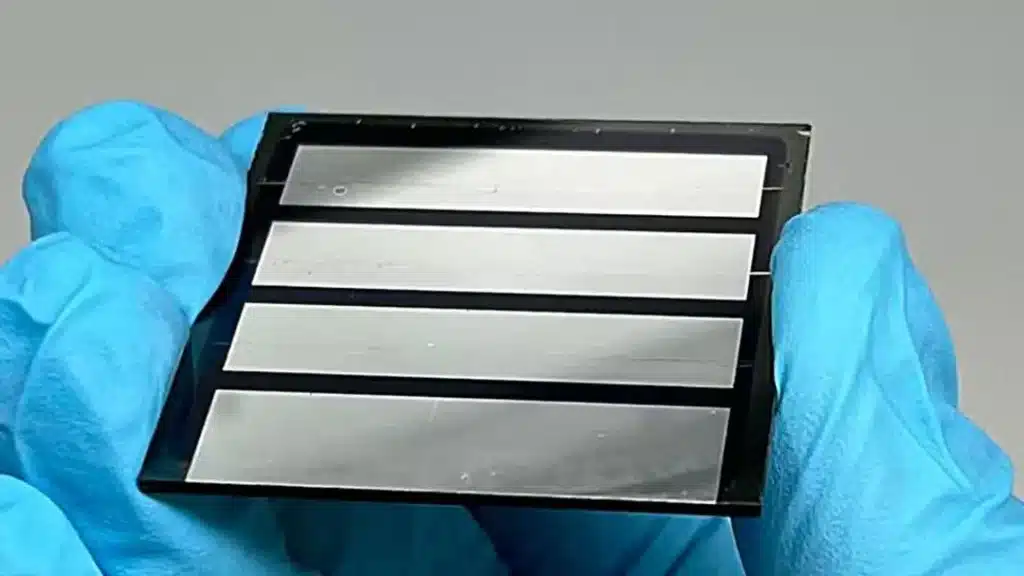
Researchers overcome long-standing instability issues using molecular coatings, delivering lightweight, flexible and heat-resistant solar cells with high power output.
Solar energy has long sought a balance between efficiency, cost and durability. While silicon dominates the market, it is heavy, rigid and expensive to produce. Perovskite solar cells promise a cheaper, lightweight and flexible alternative, but rapid degradation under heat and light has kept them from large-scale adoption. Microscopic defects in early perovskite films caused energy loss and material breakdown, creating a major barrier for commercialization.

Addressing this challenge, researchers at the University of Manchester, developed a novel “molecular glue” using small-molecule amidinium ligands. These molecules smooth the perovskite surface, eliminate defects and create a protective layer that organizes into highly stable, low-dimensional structures. By combining enhanced material stability with efficient energy flow, the team created perovskite solar cells capable of sustaining long-term performance under extreme conditions.
Testing confirmed the breakthrough that the new cells achieved a power conversion efficiency of 25.4% while retaining over 95% of performance after 1,100 hours of continuous operation. Remarkably, the cells remained stable at 85°C (185°F), proving their resilience to intense heat that would previously degrade perovskite layers. This innovation brings perovskite technology closer to practical applications, including flexible panels for curved windows, portable gear, and even wearable solar devices.
Key technology highlights:

- High efficiency: 25.4% power conversion
- Exceptional stability: >95% performance retention after 1,100 hours
- Heat resistance: Stable at 85°C
- Molecular glue: Amidinium ligands eliminate defects and smooth surfaces
- Flexible applications: Printable on curved or lightweight surfaces for versatile deployment
Professor Thomas Anthopoulos, University of Manchester, who led this experimental research, says, “Perovskite solar cells are a lightweight, flexible alternative, but stability has been the main hurdle. Our molecular glue enables controlled growth of high-quality layers, paving the way for large-scale, durable deployment of perovskite technology.”