






Spinning masses make robots jump, swim, crawl and fly, using motion to explore on Earth and beyond.
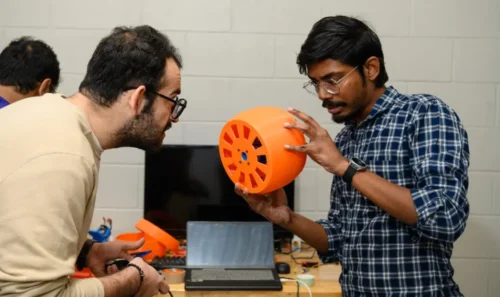
An orange wheel rolls across concrete and suddenly hops, as if it’s defying gravity. Nearby, a robot swims through water like a fish. Another twists forward inside a narrow pipe. They all look different, but they move the same way.
At Clemson University, mechanical engineering professor Phanindra Tallapragada and his team are creating robots that use centripetal force instead of complex joints, legs, or propellers.
The approach uses an unbalanced spinning mass inside each robot to generate motion. When an off-center mass spins fast enough, it creates forces that can push, lift, or twist the robot’s body. The effect is similar to a washing machine vibrating when wet clothes collect on one side of the drum.
This spinning-mass principle drives several robots in development. One is a remote-controlled wheel that jumps when the internal mass rotates fast enough to lift it off the ground. Unlike spring-based jumpers, it can repeat the motion almost instantly, making it suitable for rough or uneven terrain.
Another design is a fish-like robot that swims by transferring energy from the spinning mass into its tail. By adjusting the rotation speed, it can dive, turn, or move forward. The system is highly energy efficient compared to many swimming robots, making it applicable for monitoring lakes, oceans, or water quality.
A third robot is designed to crawl through tight pipes. Inside, a spinning mass causes small bristles on the body to compress and release rapidly. Friction with the pipe walls pushes the robot forward, enabling movement through spaces as narrow as an inch. Potential applications include inspecting ducts, gas lines, or pulling cables through long pipe networks.
The same physics is now being extended into the air. Insect-inspired flying robots are under development, where spinning masses could drive wings at the extremely high frequencies needed for flight. This work is supported by a multi-year research grant.
Beyond Earth, the concept could support planetary exploration. A single robot capable of rolling, jumping, swimming, and flying could navigate icy surfaces, leap through vents, and dive beneath frozen crusts on distant moons in search of liquid water.

