Hard to use PLCs and control machines? These displays make operation clear, show information, connect with controllers, and let factories set up custom screens fast.
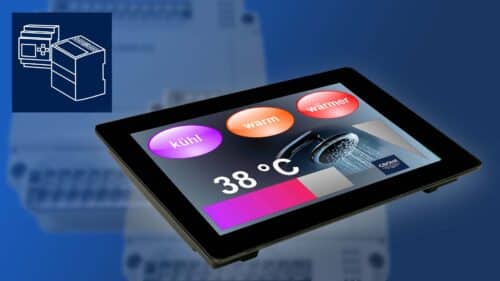
Industrial manufacturing is becoming more complex as processes rely on networked systems and real-time data. Programmable logic controllers (PLCs), once simple logic units, are now evolving into connected computing nodes that handle IIoT data, multiple devices, and new applications. This creates challenges for operators and engineers. Traditional PLC interfaces act as “black boxes” that are difficult to read, navigate, and integrate with automation systems. DISPLAY VISIONS addresses these challenges by providing human-machine interfaces (HMIs) that make processes transparent, easier to control, and simpler to operate.
DISPLAY VISIONS’ new display product line is designed for industrial environments and combines usability, performance, and connectivity. Capacitive touch technology (PCAP) and glass surfaces provide smartphone-level operation, reducing training needs and operational errors. High-brightness screens ensure readability in direct sunlight or low-light conditions. Support for Modbus TCP and Modbus RTU allows integration with a wide range of controllers. Mounting options include wall mounting or panel integration which allow displays to be used directly in machine housings or as decentralized control units.
The solution also focuses on cost efficiency. It minimizes complexity and operating costs, avoiding extra devices, software licenses, or subscriptions. Companies without display expertise can use a programming service to create custom visualizations for their processes quickly.
All development, manufacturing, warehousing, and customer support are based in Germany. This ensures quality standards and direct access to support for integration challenges.
By combining interfaces, industrial design, connectivity, and cost management, the company helps manufacturing and operations teams manage PLC systems with more clarity and efficiency. The displays bridge the gap between PLC technology and the needs of operators, supporting smoother automation, better decision-making, and reduced friction across factories.