





Why do LED displays still feel limited? A design approach removes size, wiring, and power limits, helping engineers build displays faster.
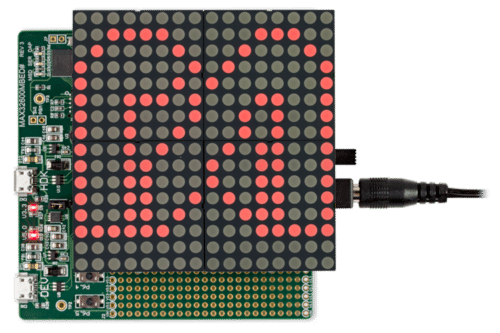
Design engineers often face challenges when trying to display information on LED matrices. Small 8×8 LED arrays are widely used, but they come with significant limitations. Characters and symbols are constrained by the size of the display, making it difficult to show larger or international characters clearly. Designers also encounter inefficiencies when multiple displays need to be connected. Without proper chaining, wiring becomes complex, and data management between multiple drivers can be cumbersome. These constraints slow down prototyping, increase the risk of errors, and limit the types of applications that can be explored, from signage to interactive displays.
Another common challenge is compatibility with different development platforms. Many LED driver solutions are optimized for a single platform, forcing engineers to spend extra time adapting code for microcontrollers that operate at different logic voltages. Voltage differences, particularly between 3.3 V and 5 V systems, can cause logic incompatibility issues, leading to unreliable display behavior or the need for additional circuitry. Power supply management adds another layer of complexity. Some setups draw too much current for USB power alone, forcing engineers to design custom power delivery solutions. These practical issues can make even simple display projects slow and error-prone, reducing the efficiency of prototyping and testing.
To address these challenges, MAXREFDES99, a flexible reference design from Analog Devices (ADI) offers a 16×16 LED matrix driven by multiple chained LED drivers. By combining four smaller 8×8 displays into a single larger matrix, it allows engineers to display larger, more readable characters and a wider range of symbols. Daisy-chaining the drivers reduces wiring complexity and simplifies data management, enabling faster iteration and testing. This approach also maximizes the use of the LED drivers’ capabilities, which are often underutilized in smaller arrays.
The design supports standard digital interfaces, making integration with microcontroller platforms straightforward. Logic-level translation ensures compatibility with both 3.3 V and 5 V systems, preventing errors due to voltage mismatch and eliminating the need for additional components. Power can be supplied through a standard external source capable of running both the display and the microcontroller, while USB power remains available for development, provided voltage limits are observed. This simplifies prototyping and reduces the risk of power-related issues.
Development is accelerated through ready-to-use libraries and sample programs for popular platforms. Engineers can focus on testing ideas and building applications rather than writing low-level driver code from scratch. The standard shield form factor ensures compatibility with existing development boards, further reducing setup time.
Compact, portable, and cost-effective, this reference design provides engineers with a practical platform for prototyping larger LED displays efficiently. It solves the core challenges of display size, driver management, platform compatibility, and power delivery. By addressing these common pain points, it allows engineers to prototype, test, and deploy LED-based projects faster, with fewer errors and less complexity.
ADI has tested this reference design. It comes with a bill of materials (BOM), schematics, assembly drawing, printed circuit board (PCB) layout, and more. The company’s website has additional data about the reference design. To read more about this reference design, click here.

