

Ultra-thin bendable silicon integrates AI compute directly on flexible substrates, enabling sub-dollar wearable health monitoring with high accuracy.
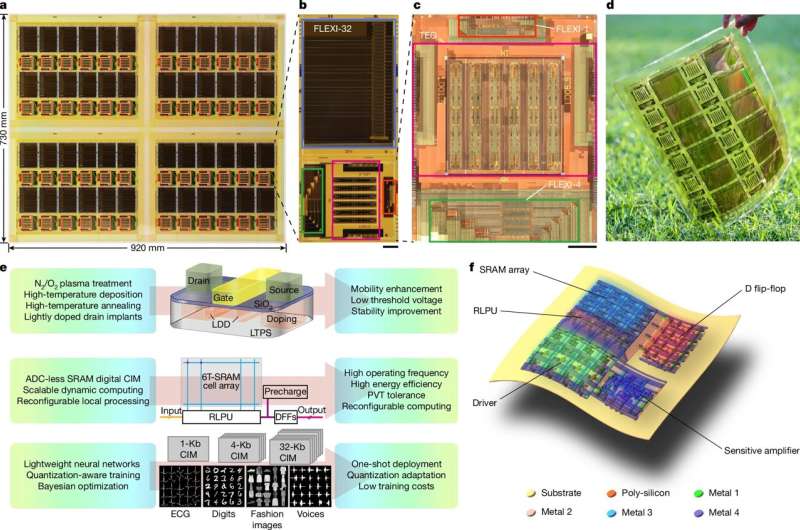
Researchers from Tsinghua University and Peking University have unveiled a flexible AI chip designed for next-generation wearable electronics that could overcome long-standing limitations in smartwatches and body sensors. The work, published in Nature, introduces FLEXI an ultra-thin, bendable AI-enabled silicon device that can process data directly on the chip rather than offloading to external processors.
Traditional wearable chips suffer from stiffness, high power consumption, and dependence on external compute. FLEXI tackles these problems by building circuits on a low-temperature polycrystalline silicon (LTPS) film mounted on a flexible plastic base. This structure is thinner than a human hair and can withstand more than 40,000 bending cycles, even to a radius as tight as 1 mm, without degradation in performance.
A key architectural shift is compute-in-memory: the chip performs AI computations where data resides, eliminating the energy and time cost of shuttling information between memory and a separate processor. This edge capability allows on-device analysis of sensor data in real time a big step for wearables that currently rely on phones or cloud backends.
In human trials, FLEXI delivered 99.2 % accuracy in detecting irregular heartbeats (arrhythmia) and 97.4 % in activity recognition tasks, such as walking and cycling. Power consumption was exceptionally low estimated at less than 1 % of conventional chips’ usage and production costs are targeted below $1 per unit, making mass deployment economically viable.
Beyond health monitoring, flexible AI silicon like FLEXI could enable smart textiles, conformal sensors, and embedded AI in garments, pushing intelligence into places rigid electronics can’t reach. Industry trends suggest growing demand for edge AI and low-power wearables, with innovations such as novel motion sensors and AR wearables also entering the market. Challenges remain in scaling the technology for more complex tasks and integrating additional sensors, but by merging flexibility with on-chip learning, this work points toward a future where wearable electronics are both smarter and physically adaptable.