




What if robots could be trained in full digital factories before touching the real world? Can a simulation model make that possible?
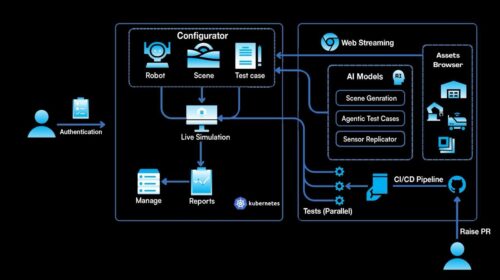
AuraML has introduced AuraSim, a multimodal world simulation model built to generate physics-ready environments for robotics. The platform converts inputs such as text, floorplans, videos, depth maps, and point clouds into simulation-ready digital twins. It is designed to help robotics teams test and train physical AI systems faster and at lower cost.
AuraSim is built on NVIDIA Omniverse and NVIDIA Cosmos, with integration of NVIDIA Isaac Sim. By combining these tools, AuraML enables developers to move from concept to deployment inside a unified simulation workflow. The system produces environments with defined collision boundaries, material properties, and sensor-level outputs, allowing teams to validate robots in realistic conditions before real-world rollout.
The model supports multiple environment generation methods. A 2D floorplan can become a structured 3D industrial space. A text description can translate into raw sensor data for training. AI agents manage an automated simulation pipeline that can run thousands of scenario variations without manual setup. Developers can also generate edge cases by adjusting prompts, making stress testing quicker.
A key application is factory automation. From a floorplan and a few walkthrough videos, users can recreate a full production facility in simulation. Within that space, they can test humanoid robots navigating corridors, autonomous mobile robots handling logistics, and stationary robotic arms performing precision tasks. The system allows teams to evaluate coordination, avoid collisions, and refine workflows before installing physical machines.
To expand usage, AuraML is launching the Global Physical AI & Robotics Cohort in collaboration with NVIDIA. The eight-week program targets robotics engineers, AI researchers, and developers, focusing on building and deploying physical AI systems through guided mentorship.
“Our integrated workflows provide the critical infrastructure needed to make Physical AI more robust,” said Ayush Sharma, co-founder of AuraML. “By launching the first multimodal world simulation model from India, powered by NVIDIA’s world-class simulation technology, we are providing a global toolset to accelerate the development of advanced robotics foundation models everywhere,” he added.


