New water-based biofuel cell ink simplifies manufacturing and powers wearable sensors without batteries.
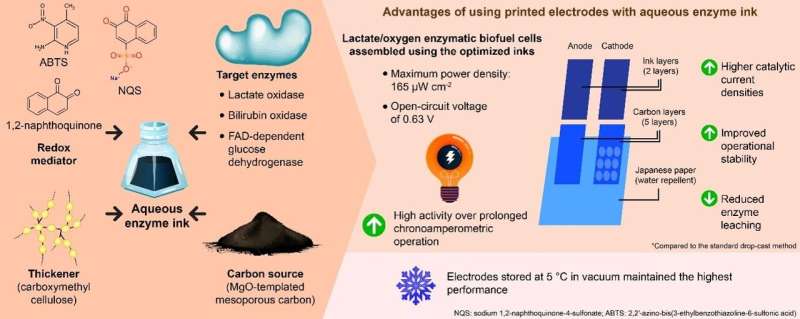
A team of researchers in Japan at Tokyo University of Science, has overhauled a longstanding manufacturing hurdle in wearable electronics by creating a printable, water-based enzyme ink for biofuel cells a development that could accelerate the rollout of self-powered wearable health devices. Wearable biosensors that analyze sweat or other body fluids are highly sought after for real-time health monitoring. Yet their broader adoption has been hampered by complex fabrication processes that require multiple steps printing electrodes, casting enzymes and drying each layer separately leading to inconsistent device quality and prohibitive production costs.
The new approach, led by researchers at Tokyo University of Science, condenses the entire process into a single screen-printing step using a specially formulated water-based enzyme ink. This ink combines all necessary components enzymes, carbon materials, mediators, and binders into a single, screen-printable mixture, eliminating labor-intensive procedures and reducing variability between devices.
By printing directly onto lightweight paper substrates, the enzyme-ink electrodes have demonstrated stronger performance and stability than conventional drop-cast electrodes in electrochemical tests. Drop-cast sensors typically lose much of their activity within minutes to hours, while the printed electrodes showed minimal performance decay.
One complete lactate/oxygen biofuel cell fabricated with the new ink delivered a peak power output of 165 µW/cm² and an operating voltage of 0.63 V, a marked improvement compared to earlier systems. Importantly, its lactate detection range aligns with physiological levels found in sweat during exercise, underscoring its practical potential for real-world wearable applications.
The device also generates sufficient power for Bluetooth Low Energy wireless transmission, suggesting battery-free operation for future sensor systems. Demonstrations of roll-to-roll printing on 400 m of substrate suggest that this method could scale to low-cost, high-volume production, potentially reducing per-device costs to around ¥10. Looking ahead, the team hopes to see the technology transition into commercial wearable platforms by around 2030. If realised, this printable enzyme ink could help bring affordable, self-sustaining biosensors into broader use from fitness and metabolic tracking to elderly care and early illness detection.