A smoke detector design that combines sensing, alarm, horn driver, temperature check, and communication in one unit, using fewer parts for fire and home safety systems.
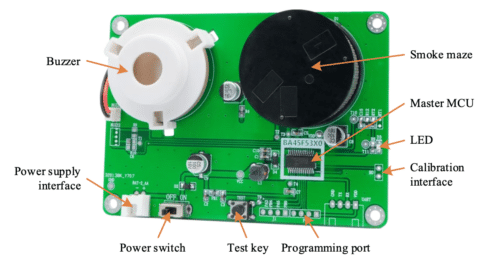
Holtek’s stand-alone smoke detector alarm reference design combines smoke detection and alarm functions in one unit. Along with standard smoke detection, it includes self-checking, hush mode (silencing), temperature compensation, fault detection, and battery under-voltage status indication. This solution is suitable for building fire protection systems, stand-alone smoke detector alarms, and home security systems.
The solution is built around Holtek’s dedicated Boost Smoke Detector MCU. The device integrates a piezoelectric horn driver with a built-in 12V boost converter. It can drive either a self-driven buzzer or an externally driven buzzer to generate a high alarm sound level. By integrating key circuits, the design reduces the number of required external components.
The MCU includes a dedicated smoke detector analog front end (AFE) for optical signal detection. The AFE contains two fully integrated operational amplifiers that detect and process optical signals from the smoke chamber. The signal gain can be adjusted through software to improve sensitivity, and an input offset calibration function is provided to reduce signal distortion.
For IR operation, the device features a dual-channel IR LED constant current driver circuit that supports both dual transmission and single reception. It also integrates a sink current generator that delivers a constant current from 50mA to 360mA for IR LED driving, provided the sink voltage remains within 1.0V to 4.5V.
The internal horn driver, together with the boost converter, removes the need for external driving components. The boost circuit raises the 3V input voltage to 12V, allowing the system to drive a piezoelectric horn at a high sound level.
Compared with traditional solutions, this design significantly reduces the number of external components by integrating the smoke detector AFE, IR transmitter driver circuit, and horn boost driver into a single device.
The device also provides a Universal Serial Interface Module (USIM) that supports SPI, I²C, and UART communication. This enables expanded functionality for different smoke detection alarm applications. In addition, the system can dynamically switch between multiple operating modes, allowing users to minimize power consumption.
For temperature compensation, the system works with a temperature sensor to automatically adjust the alarm threshold. The default alarm threshold is set at 25°C. Within an ambient temperature range of –10°C to 60°C, the solution measures the surrounding temperature. Using data converted by the internal 12-bit A/D converter, temperature compensation is applied accordingly.
The detector uses the photoelectric detection method. Its main structure includes an optical maze fitted with an IR transmitter and an IR receiver. Under normal conditions, when no smoke is present, only a small amount of infrared light reaches the receiver, resulting in a low output signal from the internal amplifier.
Holtek has tested this reference design. It comes with a bill of materials (BOM), schematics, assembly drawing, printed circuit board (PCB) layout, and more. The company’s website has additional data about the reference design. To read more about this reference design, click here.