From confronting bias in tech to creating inclusive communication tools, Aishwarya Karnataki’s journey with Glovatrix has been long. She tells Nidhi Agarwal in EFY’s Women Power Series how the startup is breaking barriers for deaf communities.
Q. What inspired you to begin this journey, and what was the moment that made you take the leap?
A. The journey began with a simple realisation: communication is something most people take for granted. Growing up, I moved across eleven cities in my first eighteen years, which made me aware of how strongly language shapes human connection. The turning point came when I started interacting closely with the deaf community and saw how everyday activities, such as ordering food, attending a lecture, or speaking with a doctor, could become difficult simply because others could not understand sign language.
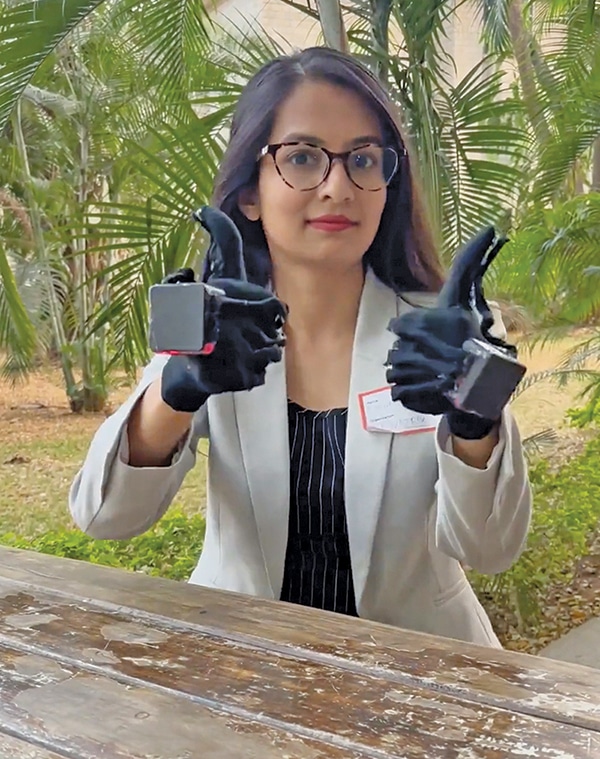
One moment that stayed with me was meeting a young deaf child who struggled to express himself in a room full of people who could hear. That experience led to a simple question: what if technology could bridge this gap instantly? That question eventually led to Glovatrix, where the team is building technologies such as Fifth Sense smart gloves and MIRA sign-language avatars to make communication more accessible.
Q. What were the biggest challenges you faced as a woman, and how did you overcome them?
A. One of the biggest challenges in the initialdays was being taken seriously in deep techspaces. I remember a meeting where I had gone to demonstrate an early prototype of our sign-language translation technology. Most of the technical questions were directed to the men in the room, even though I had built the concept and understood the system in detail. Instead of reacting, I opened the prototype and explained how the sensors worked, how gesture data was processed, and how the AI translated it into speech. As the discussion continued, the mood shifted from scepticism to curiosity. By the end, the same people were asking detailed questions about the technology and the roadmap. Thisexperience reinforced that credibility is demonstrated through the work.
Q. Did you face bias from others or self-doubt because of your gender?
A. Yes. Bias also appeared in subtle and direct ways. After one presentation, someone told me, “You do notreally look like an engineer.” Another time, after we secured an early partnership, someone joked that the deal might have worked because I was a young woman with a convincing smile. Comments like these can quietly create doubt, especially when you are already navigating the uncertainty of building new technology.
A milestone came during the development of our early prototypes. During one test, the system suddenly stopped working; the sensors behaved unpredictably, and the software misread gestures. Instead of rushing into quick fixes, I retraced every step, observing how gestures were performed and comparing what the sensors captured with what we expected. After about two hours, we discovered the issue: a small calibration mismatch between the sensors and wrist orientation. Once we corrected it, the system worked again.
That moment reinforced an important lesson. The stereotype of how an engineer should look or behave is narrow. In reality, building technology requires patience, observation, empathy, and careful listening to both people and machines. Those qualities helped us solve problems and continue building with confidence.
Q. Can you share a failure or setback that became a turning point in your growth?
A. In the early days of Glovatrix, I once pitched the idea to a group hoping for support. After hearing the concept, someone said, “It is a noble idea, but accessibility technologies rarely scale. It isnot really a viable business.” The meeting ended there, and for some time, that comment stayed with me. It made me question whether solving accessibility at scale was truly possible.
A few days later, while testing our prototype with a deaf professional, he signed to the interpreter, “If this works, I will nothave to ask someone to speak for me all the time.” That moment reminded me why the problem mattered. Instead of seeing accessibility as a niche area, I began to see it as an important direction for technology. Years later, that journey led Glovatrix to win the WIPO Global Award in Geneva, and the technology has been used to translate national-level speeches, such as the Prime Minister’s address at the India AI Summit.
Q. How did your family or support system influence your journey, and how did you balance personal and professional responsibilities?
A. Entrepreneurship may look like an individual journey, but it is supported by many people who believe in the vision. My family has been my first source of support. When building something new, there are phases with uncertainty; no clear revenue and no guarantees. Their belief in the idea gave me the confidence to continue during difficult periods. I also believe balance is not about dividing time equally between work and personal life, but about working toward a purpose that matters.
The deaf community has been another strong source of motivation. Their feedback during early prototype testing helped shape the product and reminded us that the goal was not just to build technology, but to enable communication and opportunity. Organisations like Royal Orchid Hotels supported pilot programs, while Coreco Technologies helped us develop the product during phases when resources were limited. These experiences showed that startups are built not only with funding, but also with trust and belief from people who support the mission.
Q. What keeps you motivated during tough times, and what belief has guided you throughout your journey?
A. Entrepreneurship often brings difficult phases: prototypes fail, funding takes time, and the path forward can feel uncertain. During those moments, what keeps me motivated is the real human impact behind the technology we are building. Over the years, conversations with members of the deaf community have stayed with me. One deaf professional once told us, “This technology did notjust help me get a job. It gave me dignity.” That statement reflects why this work matters.
For many deaf individuals, communication barriers affect education, employment, and everyday interactions. When technology helps remove those barriers, it restores confidence and independence. In difficult moments, I remember that we are not just building devices or software; we are helping create a world where communication does not limit someone’s opportunities. The belief that guides this journey is simple: technology should not only make life easier, it should also make life fairer.
Q. Have you introduced any changes in your organisation as a woman leader, such as inclusive policies, mentorship, or cultural shifts?
A. Inclusion is not just a value discussed at Glovatrix; it is something the organisation actively practices. Today, the workforce includes 50% women and 50% deaf professionals, creating a collaborative environment where different perspectives come together. Having deaf team members directly involved in product design, testing, and feedback ensures that the technology reflects real communication patterns rather than assumptions made by hearing developers.
This approach has also shaped the organisation’s culture. Engineers, designers, and members of the deaf community work closely, helping build solutions that are technically sound and linguistically accurate. For Glovatrix, inclusion is not only about representation but about co-creating technology with the people whose lives it aims to support.
Q. What common mistakes should aspiring women entrepreneurs/leaders avoid, and what would you do differently if starting today?
A. One common mistake is waiting for perfect conditions before starting. Entrepreneurship rarely begins with certainty. Most successful startups begin with an idea, a small prototype, and a willingness to learn quickly. If starting today, the focus would be on building partnerships and global collaborations earlier, because innovation grows faster when ecosystems work together.
Q. How is the ecosystem evolving for women leaders/founders, and what message would you give to the next generation of women aspiring to be leaders like yourself?
A. The ecosystem today is more supportive than it was a decade ago, with more grants, accelerators, and global platforms encouraging women founders. At the same time, an important shift must also come from within. Women should feel confident entering fields like AI, hardware, and deep technology, which are often seen as male-dominated. My message to the next generation is simple: do notwait for permission to lead. Focus on building something meaningful, and leadership will follow naturally.
Q. What are the three things that society (or the other gender(s)) can undertake to make it easier for future women leaders to rise to the top?
A. One important step is to stop treating women in leadership or technical roles as something unusual. Many women still walk into rooms where people are surprised to see them as engineers, founders, or decision-makers. When that surprise disappears, and competence is seen as normal, it becomes easier for more women to participate and lead. Another step is to judge people by their work rather than their appearance. Innovation does not depend on how someone looks. Ideas, prototypes, and results should be the main focus.
A third step is to remove the barriers that slow women down. Women do not need special treatment or extra praise. What helps most is equal access to opportunities, funding, and decision-making spaces. When these conditions exist, more women can grow into leadership roles. If society moves in this direction, the next generation of women leaders will spend less time dealing with obstacles and more time building new technologies and businesses.