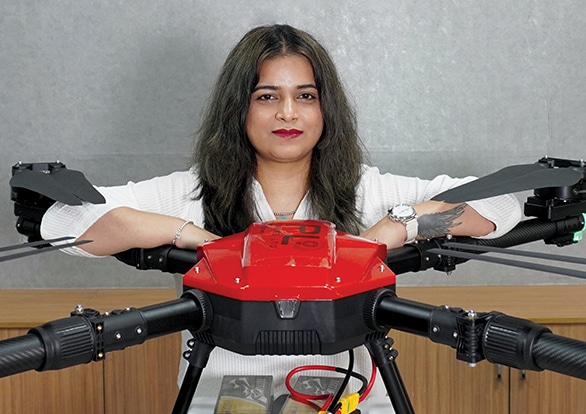
In EFY’s Women Power Series, Dr Preet Sandhu of AVPL International joins Nitisha Dubey to discuss how drones are uplifting rural youth, driving indigenous innovation, and reshaping women’s leadership in India’s fast‑evolving drone ecosystem.
Q. What inspired you to start your entrepreneurial journey, and what was the defining moment that made you take the leap?
A. My entrepreneurial journey began with a strong desire to bridge the gap between industry and academia. After completing my MBA in 2011, I noticed that many talented young people struggled to find meaningful employment opportunities.
The defining moment came in 2016 when we founded AVPL International. Initially, we focused on training rural youth for jobs, but many were reluctant to migrate for low-wage employment. This realisation pushed us to rethink our approach. Inspired by government initiatives promoting precision farming, we shifted towards enabling self-employment through drone technology in agriculture. This marked the beginning of a mission to empower rural communities with advanced technology and sustainable livelihoods.
Q. What were the biggest challenges you faced as a woman, and how did you overcome them?
A. One of the biggest challenges was the scarcity of skilled talent in the nascent drone sector. Experienced drone pilots were few and often demanded very high salaries, while newcomers lacked practical expertise. At the same time, the broader ecosystem for emerging technologies was still developing.
As a woman entering India’s drone industry early on, commercialising deep technology with limited resources was particularly challenging. However, we turned these challenges into opportunities by investing in indigenous research and development (R&D) and aligning with the ‘Make in India’ vision. Building our own capabilities helped us move forward despite the constraints.
Q. Did you face bias or self-doubt because of your gender?
A. Operating in a male-dominated field inevitably came with certain biases. At times, intermediaries attempted to exploit the industry’s talent scarcity. Instead of relying on such channels, we chose a different path by building direct collaborations with academic institutions, particularly the Indian Institutes of Technology, and focusing on in-house R&D.
While moments of self-doubt can arise for anyone, staying grounded in a clear vision and purpose helped me remain focused. Leadership rooted in empathy, attention to detail, and clarity of thought allows teams to align naturally and work effectively toward shared goals.
Q. Can you share a failure or setback that became a turning point in your growth?
A. One early setback came when we realised that the jobs our trainees were getting were not attractive enough for them to leave their villages. Many were unwilling to migrate for low-paying roles.
This insight became a turning point. We pivoted to a self-employment model built around the idea of ‘one drone, one village.’ Through this approach, trained drone entrepreneurs could earn up to ₹800,000 annually while serving local agricultural communities. In 2024, we certified our first agriculture drone, validating the model and opening pathways into other sectors such as defence and deep-tech applications.
Q. How did your family or support system influence your journey?
A. My husband, Deep, Founder and Chairman, has been a constant pillar of support. Since 2013, we have worked together closely while building the organisation from the ground up.
Balancing personal and professional responsibilities has been made possible by our shared long-term vision. By focusing on clarity, collaboration, and sustainable growth rather than chasing short-term revenue, we have been able to maintain harmony between work and family life.
Q. What keeps you motivated during tough times?
A. A core belief that keeps me going is that every problem has a solution. Challenges are opportunities to collaborate, learn, and innovate.
What truly motivates me is witnessing technology create meaningful change, whether it is empowering rural youth with new livelihoods or enabling agricultural transformation through drones. Initiatives such as ‘Invincible Bharat 5.0’, which identify real-world problem statements, further strengthen our mission to build impactful solutions.
Q. Have you introduced any changes in your organisation as a woman leader?
A. As a woman leader, I emphasise inclusive collaboration and empathy-driven leadership. We actively partner with academic institutions, including the Indian Institutes of Technology (IITs), to strengthen research and innovation.
We also run initiatives such as ‘Drone Didi’, which empowers rural women by training them to use drone technology confidently. Our training hubs prioritise women participants and encourage a culture where problem-solving and innovation matter more than hierarchy.
Q. What common mistakes should aspiring women entrepreneurs avoid?
A. One of the biggest mistakes is rushing to adopt the ‘founder’ label without thoroughly validating the business model. Ideally, an idea should go through at least 400–500 validations before scaling.
Another mistake is chasing funding or pilot projects without identifying core gaps. If I were starting again today, I would focus even earlier on building large communities of rural women and leveraging digital platforms to amplify impact.
Q. How is the ecosystem evolving for women leaders, and what message would you give to the next generation?
A. India’s entrepreneurial ecosystem for women is expanding rapidly. With more than eight million women entrepreneurs and initiatives such as ‘Startup India’ and ‘Atmanirbhar Bharat’, opportunities for women founders are increasing across sectors, including deep tech.
My message to the next generation is simple: specialise deeply at a young age, build strong frameworks to manage multiple roles, and lead authentically. Confidence in your vision matters far more than external validation.
Q. What three changes can society make to help more women leaders succeed?
A. There are many possible changes, but three stand out as crucial. First, normalising male mentorship and allyship can help challenge stereotypes and build stronger support systems. Second, enabling policies must be strengthened to ensure safe transport, childcare facilities, and clear re‑entry pathways for women after maternity breaks. Finally, shifting societal mindsets to recognise women as natural leaders, without qualifiers such as ‘women‑led’, is essential to supporting their presence in sectors like deep tech.