Robot task AI learns everyday work from human demonstrations. It breaks tasks into steps and performs them on real robots, reaching over 90% success in real environments.
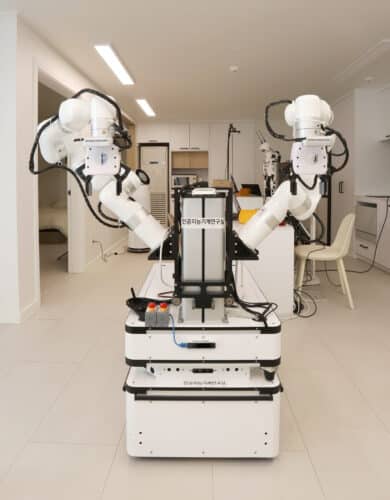
Korea has developed a robot task AI that learns everyday work from human demonstrations and performs the tasks step by step. The system can carry out activities such as organizing items, clearing tables, and manipulating objects, with the goal of automating repetitive work in homes, offices, retail stores, and logistics facilities.
The team built a system that observes how humans perform tasks and then reproduces them through a structured execution process. In testing, the system achieved a task success rate of more than 90 percent across different activities. It was integrated with a real robot platform and evaluated in real environments to verify that it can perform outside controlled laboratory settings.
The technology works through three main components. The first converts human task demonstrations into training data. The second recreates real environments in virtual space so robots can train and be validated under many conditions. The third is a hierarchical task execution AI that breaks complex work into smaller steps and completes them sequentially.
This hierarchical structure allows the robot to manage multi-step activities rather than isolated actions. By using virtualized environments, the system can also generate training data under varied conditions, helping the robot maintain stable performance even when objects or surroundings change.
Earlier robot task systems were often limited to single-task datasets or simulation-only testing. The team instead built a full development pipeline that includes dataset creation for many everyday tasks, virtualization of real environments, AI task execution, and verification on real robots in real-world scenarios.
The technology could be applied in several service settings. These include household and office assistance, product arrangement in retail stores, and picking or organizing items in logistics operations.
Accurate collection of human task data is important for improving the performance of robot task AI systems. To support this, the team developed an interface that enables precise task data capture while still allowing flexibility during task demonstrations. The researchers also plan to release the collected task datasets and virtual environment models so other groups can use them for service robot research and industrial applications.