Artificial components are being made to act like real muscles. Could this be the future of robots? Find out!
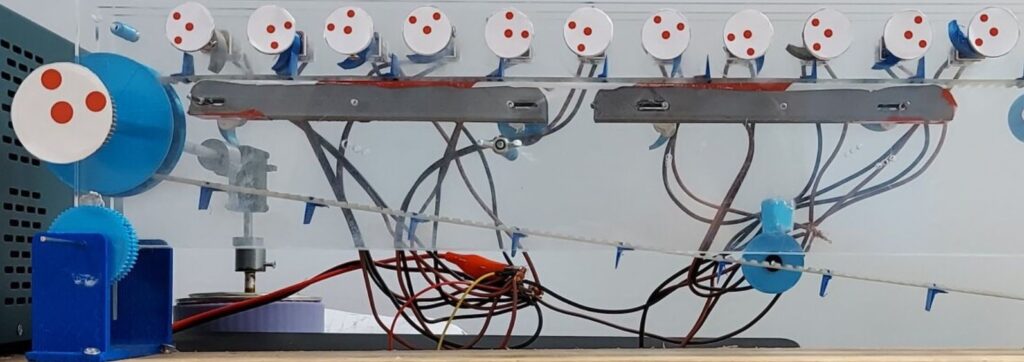
Researchers at the University of Bristol have created a network of simple mechanical motors that act similar to human muscles responding to increasing load. The system mimics the coordinated action of actomyosin, the protein complex responsible for muscle contraction, and is built using small electric motors, 3D-printed parts, and acrylic components.
Despite its simplicity, the network can reproduce muscles’ ability to recruit “additional” motors as demand rises. The finding improves understanding of how parts work together in biological systems and may help develop more efficient and adaptable artificial muscles for future robots and bio-inspired machines.
Motors mimicking muscles
The demonstration of simple mechanical motors replicating the behaviour of actomyosin was done by designing a physical model where motors interact only through brief mechanical contact within a carefully arranged structure.
To validate the concept, the team built a tabletop device using small electric motors configured to resemble the organization of muscle proteins. Despite its simplicity, the device spontaneously self-organized into coordinated traveling waves of motion and adapted automatically as mechanical load increased. As each motor pushes against a shared backbone, it alters the forces experienced by others, leading to collective synchronization over time.
Adaptive muscle systems
The findings indicate that muscle-like coordination may emerge not only from complex biochemical processes but also from the underlying physical architecture of a system, highlighting the role of structure and mechanical interactions alongside molecular chemistry.
Researchers note that this approach opens new possibilities for creating machines that respond dynamically to external forces. At the same time, the findings raise important biological questions about the extent to which muscle function depends on chemical signaling versus structural organization. Understanding this balance could provide deeper insight into muscle performance and failure.
In soft robotics, it could help create artificial muscles that adjust to changing conditions on their own, reducing the need for complex control systems.