



The rotary switch-selectable timer for industrial and domestic applications is designed as a robust and practical timing device for systems that require fixed delays with minimal user intervention. In many real-world settings, particularly on shop floors and within household control units, simple hardware-based timers are often preferred over programmable devices. A rotary switch position enables quick selection of the required delay time, allowing even non-technical persons to operate an appliance easily.
POC Video Tutorial
In industrial environments, such timers are commonly used for motor start delay, conveyor sequencing, lubrication systems, heater control, and protection circuits where a defined waiting period is required before switching a load. In domestic settings, the device supports applications such as pump automation, staircase or garden lighting, exhaust fans, water heaters, and appliance protection. The ability to select preset timings improves operational consistency and reduces the risk of accidental misconfiguration.
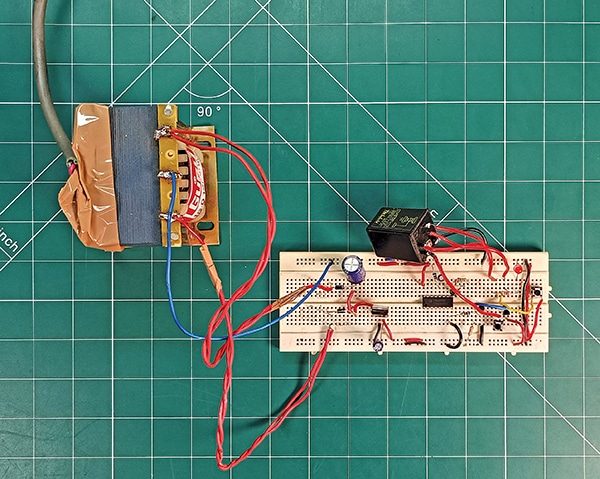
The design does not rely on software. By avoiding microcontrollers, the circuit eliminates concerns such as program corruption, debugging complexity, and dependence on specialised tools. As a result, the device remains well-suited for harsh environments, long-term operation, and straightforward maintenance. Fig. 1 shows the author’s prototype.
Rotary Switch Timer Circuit and Working
Fig. 2 shows the circuit diagram of the rotary switch-selectable timer for industrial and domestic use. The device is built around an LM7812 voltage regulator (IC1), a CD4060 CMOS counter IC (IC2), and a few discrete components.