





A new compact driver solution improves reliability, speeds switching, and reduces component count in next-generation EV and high-voltage systems.
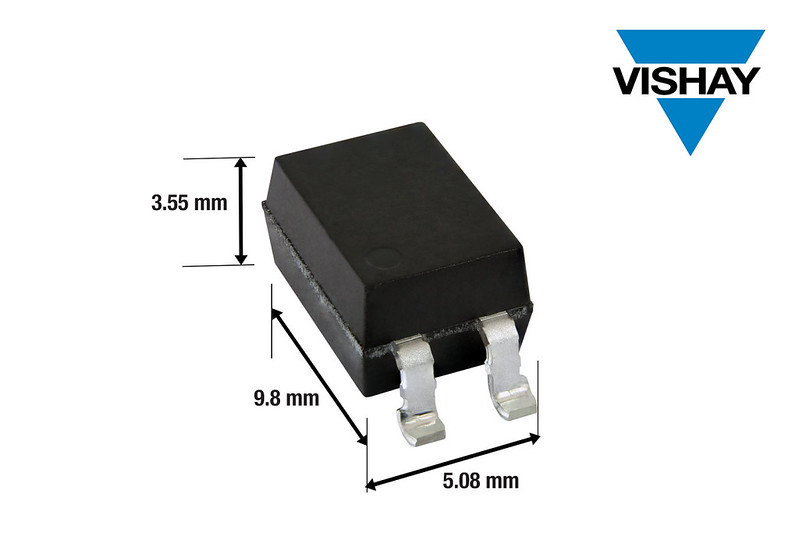
A newly introduced automotive-grade photovoltaic MOSFET driver from Vishay Intertechnology, Inc. targets improved safety, faster switching, and lower system costs in high-voltage applications such as electric and hybrid vehicles. Designed for compact integration, the device combines reinforced isolation with high electrical performance, helping engineers simplify circuit architectures while meeting stringent automotive requirements.
The key features are:
- 20 V typical open-circuit output voltage
- 20 μA short-circuit current
- Fast 80 μs turn-on time
- 8 mm creepage distance with CTI 600 insulation
- High isolation: 1260 V peak working, 5300 VRMS test voltage
At the core of the device is its ability to deliver a typical open-circuit voltage of 20 V and a short-circuit current of 20 μA, enabling efficient and reliable driving of MOSFETs and IGBTs. With a turn-on time of just 80 μs—significantly faster than comparable solutions—it supports quicker switching, which is critical in high-voltage battery systems exceeding 800 V.
The driver is built in a space-saving SMD-4 package while maintaining an 8 mm creepage distance and a mold compound rated at CTI 600. This combination enhances insulation reliability and supports reinforced isolation, making it suitable for demanding automotive environments. Its isolation ratings include a working voltage of 1260 V peak and a test voltage of 5300 VRMS.
The device is particularly suited for pre-charge circuits, battery management systems, and onboard chargers. By providing a higher output voltage, it eliminates the need for multiple drivers connected in series—a common workaround in earlier designs—thereby reducing component count, saving board space, and lowering overall system costs.
Another notable feature is its optical isolation architecture, which derives operating energy from an internal infrared emitter. This removes the need for an external power supply on the secondary side, further simplifying system design and improving efficiency.
With automotive qualification and compliance with environmental standards, the device also supports the transition from mechanical relays to solid-state alternatives in modern vehicle platforms.
Click here for the original announcement.
