Alloy breakthrough signals a new era where hidden structural design hints at stronger, longer-lasting materials shaping future industries.
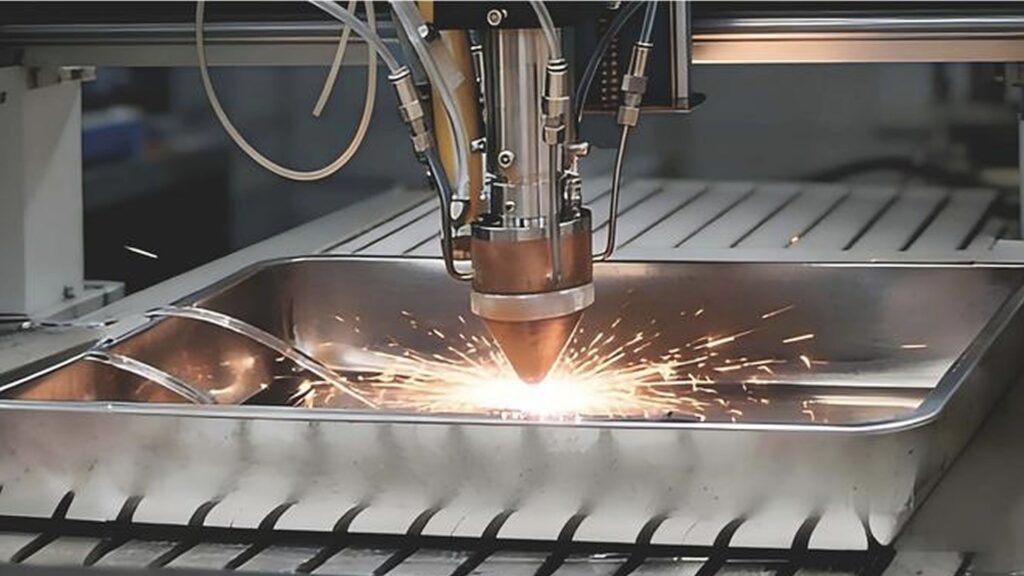
Researchers from the University of South China and Purdue University have successfully employed artificial intelligence (AI) to create a new high-strength, ductile 3D-printable form of steel. They have developed this alloy that offers a promising direction for next-generation industrial materials. The innovation lies in its carefully engineered internal structure, where tiny nanoparticles play a critical role in enhancing performance under stress.
These nanoscale particles are distributed throughout the metal and act as barriers that prevent cracks from spreading. When the material is subjected to stress or strain, these particles help maintain structural integrity by stopping microscopic fractures from growing into larger failures. In addition, the alloy features specialized “shock absorber” zones within its structure. These regions can deform under pressure, allowing the material to absorb energy rather than snap, significantly improving its durability.
Another major advancement is the alloy’s resistance to corrosion. In conventional steels, elements like chromium often become trapped in carbides over time. This process reduces their effectiveness and creates weak points where rust can develop. In contrast, the new alloy maintains an even distribution of chromium throughout its structure. Copper nanoparticles assist in this process by helping reposition chromium atoms if they begin to shift, ensuring consistent protection against corrosion. This design allows the alloy to rival the performance of stainless steel in resisting rust.
Mechanical testing has revealed impressive physical properties. The alloy demonstrates a strength of approximately 1,730 megapascals (MPa), placing it among high-performance materials. At the same time, it retains a ductility of 15.5 percent, meaning it can stretch significantly before breaking. This represents roughly a 30 percent improvement compared to its original, unprocessed state, highlighting the effectiveness of its refined microstructure.
Industries like aerospace, defense, energy, and heavy engineering could benefit from lighter, more durable components. For instance, aircraft parts could become both stronger and lighter, improving efficiency. Similarly, offshore wind turbines, oil pipelines, and other infrastructure exposed to harsh environments could see increased longevity and reduced maintenance requirements.