





A wearable device that you can open, modify, and build on. With sensors, wireless support, and modular hardware, it changes how devices are created and used.
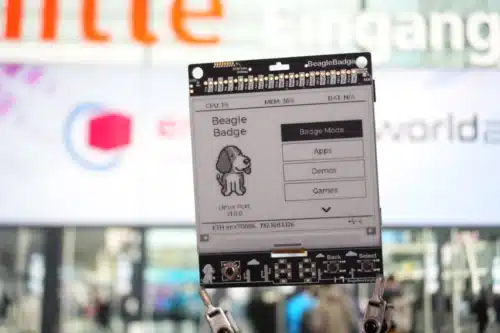
BeagleBoard.org Foundation is trying to solve a problem in wearables. Most devices are closed, so people cannot access or modify them. The BeagleBadge is built as an open platform to change this. It gives users control over hardware and software while supporting use.
BeagleBadge combines sensors, wireless connectivity, and expansion support in a wearable format. It can be used for prototyping, research, and applications like health tracking, environmental monitoring, and human machine interaction. The platform is designed around four ideas: access, literacy, ownership, and long term use. Users can learn, modify, and keep using the device over time.
Out of the box, it is ready to use. It includes a 4.2 inch ePaper display with Linux support, along with MicroPython and LVGL for building interfaces. Users can start building without setting up tools.
The device includes Wi Fi 6, Bluetooth, and LoRa connectivity. It also has an accelerometer and gyroscope for motion sensing, along with temperature, humidity, and ambient light sensors. For interaction, it provides a joystick, buttons, a buzzer, an RGB LED, and dual 7 segment displays.
Its modular design allows expansion. It supports QWIIC, Grove, and mikroBUS connectors, so users can add external modules without soldering. This includes sensors like pulse oximeters, GPS, fingerprint readers, UV sensors, and audio or haptic modules. The hardware design is open, so users can study and modify it.
Inside, the device runs on a Texas Instruments AM62L32 dual core Arm Cortex A53 processor at 1.25 GHz. It includes 256MB LPDDR4 RAM and 256Mb flash storage. Wireless connectivity is handled by a BeagleMod CC3301 module for Wi Fi and Bluetooth, along with LoRa support using a Wio SX1262 module. It also supports battery operation with management for a BL 5C Li Ion battery.
On the software side, it supports Linux and Zephyr, following a mainline development approach. It also includes an app store with example applications and supports tools like Meshtastic and ActivityPub for communication, including off grid messaging.
Click here for the original announcement.

