Intelizon was founded by Dr Kushant Uppal, a global professional with 20-plus years of technocommercial success. He returned to India to develop a unique solar-based light system to light up our streets. Wireless outdoor lighting solutions are at the core of Intelizon’s success and innovation.
Solar streetlight is a US$ 3 to US$ 4 billion market globally. It is estimated to grow to US$ 15 billion by 2024. The market is dominated by regional and local players with customised specifications.
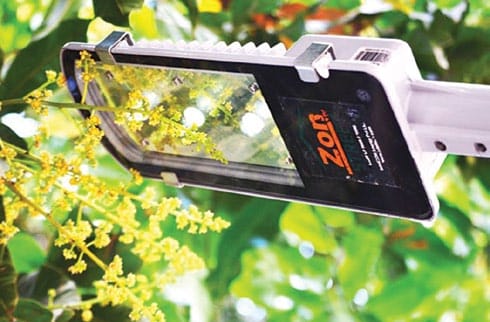
sensor, turns on in the evening and provides 10 to 12 hours of lighting at night
The market has faced many field issues over the years. Companies like Intelizon are proving the reliability that has led to the acceptance of lithium-ion batteries. (Recently, MNRE mandated all state government to stop using lead-acid batteries and transition to lithium-ion ones for solar streetlights). Quite a few brands are expected to emerge in the next three to five years.
Lack of reliable products lead to the focus on lithium-ion-based solar systems. In the case of treetlights, lead-acid solar systems had theft as well as performance issues, leading to field failures.
Intelizon already had innovative and reliable home lighting systems, but their channel partners asked for in-built lithium-ion-based solar streetlights to address the field issues. Intelizon, with their Gambia partner, initiated the idea for in-built lithium-ion-based solar streetlights.
The process
Designing a reliable system was the main challenge for Intelizon team. They faced installation-related as well as environmental issues. These were addressed with redesign. Today, they have systems working in the field for more than five years.
Solar panels charge the battery during the day. The battery then provides power to the LED, which runs all night. Intelizon has auto-dimming, self-autonomy (efficient charging and performance even on cloudy days ), remote monitoring and control as well as inbuilt CCTVs as some of the key features in their models. There is a strong technology element with optics (LED and lenses), solar, battery, firmware, hardware and software coming together to create advanced and reliable systems.
Operational limitations. The company currently limits the operating conditions between 0°C and 50°C. There are certain regions globally that require extreme temperature operations at sub-zero or 60°C. Incubation and funding. Intelizon was incubated at IIT-Madras, and raised venture capital to develop the technology for home lighting systems. Initial product knowledge was leveraged to develop more complex outdoor lighting systems.
The company did not raise further funds and took about one year to design the system and another year to make it field reliable. Consumer benefits: Outdoor solar lights have a great value proposition in Greenfield locations where underground cabling costs can be saved.
There is also additional savings on electricity and maintenance costs, and protection from power outages. Some applications where Intelizon lights have been installed are urban communities, commercial offices, schools, colleges, hospital campuses, rural areas, farmhouses, streets and factories. The target customers are private companies as well as government agencies. Marketing the solution The company appoints local channel partners globally who work with local companies and governments to promote its technology and products, while participating in tenders.
Intelizon is one of the few companies globally that can claim to have lithium-ion-based solar streetlights operating in the field for more than five years. Companies from China as well as local companies in India have introduced inbuilt lithium-ion-based solar streetlights.
However, reliability and design flaws have led to field issues. For example, there are many companies promoting a model with in-built solar panels with the light. This has an inherent issue, since solar panels need to face south (for efficient charging),
while light needs to face the street. Intelizon has also introduced GSM-based solar streetlights for remote monitoring and control, as well as inbuilt CCTV-based lights for which there is no competition today.
| Have an idea and want to become an entrepreneur, or become an entrepreneur and look for an idea? |
This is a typical chicken and egg situation! Let us not worry as to which came, or should come, first—the idea or the drive to become an entrepreneur. The outcome should be a good product/solution by you, which is required by many. The idea can be something that generates revenue, or something that helps society but does not earn profit. Either way, you are contributing. There are two routes that you can take. Decide to become an entrepreneur first—while you may not know exactly what product/service you can offer—and start looking for opportunities around. Find an opportunity, and work around it. Alternatively, you notice a problem with a product/ solution/process and come up a solution for that. This may lead to your entrepreneurship. Either way, how can you be sure that it would work? Use your experience. While working in a company you may notice some issues. To overcome those issues, you think of a solution. That triggers the idea of making a product/solution to make your life and the lives of those in similar fields easy. If your quick research says there are many users like you, you can think of making a product/solution. In a manufacturing environment, many departments need to share data among themselves, which is cumbersome. If all departments can communicate, it is easier to manage the flow of data. If one has multiple factories, it becomes difficult to manage all of them efficiently. This is why enterprise resource planning (ERP) systems were designed, to integrate multiple locations. Remove pain points. As a user, you notice some problems in a process and analyse the same. You realise that there is a pain point that you can remove. Bharat Goenka realised that small- and medium-size enterprises did not have a good financial accounting system, and he developed Tally. Tally software has made accounting extremely simple. It is the highest-selling accounting package in India today. Add value to the process. Someone is doing a good job, but there is scope for improvement. You apply your mind as an end user and look for additional features to make the existing product/solution better. Phanindra Sama realised that private buses were doing good business by selling tickets in their offices. He thought that it may be a good idea if the users could buy tickets and book seats in buses online. He had an idea, but implementation was difficult. Private bus owners did not understand why they should let someone else sell their bus tickets when people were coming to their shops to buy them. Sama managed to convince a bus operator to let him sell a few tickets. Once this bus operator realised that the new online ticketing system is much easier, acceptance came from many more bus operators. Hence, Redbus was born! Me-too products. You may know that ex-employees of Amazon started Flipkart. If you understand a market well, nothing can stop you from entering that segment and making it big. Where there is competition, there is opportunity. Otherwise, there would not be multiple players in the segment. Each player can get a share. The biggest advantage of me-too products is that they are already tried and tested. Everything depends on your innovative marketing skills! Something new. You have your Eureka moment and see a good scope for a product. It could be a really good opportunity. However, do not get carried away with your idea. Check to make sure that there is a market for your idea. Find the target audience and talk to them. Find out if they are willing to pay for the same. Whatever be the source, once you zero in on the idea, evaluate the market potential and whether it has potential for a profit-making business or for helping others. Keep your ears and eyes open. There will be many opportunities. You just need to observe carefully. —Rajesh Kumar Reddy, early-stage startup mentor |
Their installed systems cost between ₹10,000 and ₹ 60,000 depending on the features and light output requirement.
The company has an in-house R&D team that continues to innovate. The current models are already two to three years ahead of competition. And, the upcoming proprietary technologies that the team is working on will put Intelizon at least five years ahead of the curve.