What if fake currency and forged documents could be stopped using a light-based technology that changes patterns with heat and chemicals, making copying difficult?
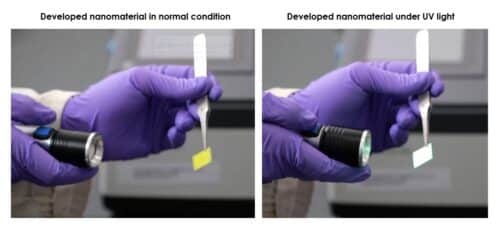
Researchers at Indian Institute of Technology Guwahati have developed an advanced light-emitting perovskite nanomaterial that could significantly strengthen protection against counterfeit currency, forged documents, and fake products. The research team created nanocrystals capable of generating light-based security patterns that are extremely difficult to replicate using conventional printing or imaging technologies. These nanocrystals, thousands of times smaller than the width of a human hair, can emit highly pure and intense colors with extremely narrow emission ranges.
This characteristic enables the generation of precise optical signatures and offers greater color tunability compared to conventional fluorescent materials, making them highly suitable for secure authentication applications. However, perovskite materials are generally vulnerable to moisture, heat, and environmental degradation.
To overcome this limitation, the research team engineered a double-layer protective coating around the nanocrystals, enhancing their resistance to heat and chemicals while preserving their light-emitting performance.
Using a direct laser writing technique, the researchers then fabricated microscopic patterns from these coated nanocrystals. The multilayer coating allowed the patterns to be created without traditional lithographic masks, achieving resolutions between 10 and 40 micrometers and enabling the encoding of highly intricate information.
]As a result, counterfeiters would not only need to replicate the visible pattern but also mimic the nanocrystals’ precise responses to heat and chemicals, making duplication significantly more difficult through conventional methods. The technology also opens possibilities for embedding secure information into products and banknotes for advanced data storage and authentication.
The researchers have termed this innovative approach “4D anticounterfeiting.” Beyond security applications, the laser patterning technique developed by the IIT Guwahati team could also support the development of next-generation micro-LED displays for smartphones, wearable devices, and Augmented Reality systems.
On a broader scale, the technology has potential applications across sectors where authentication and security are critical, including currency protection, passports, identity cards, legal documents, luxury goods, and consumer products.