

What if AI performance gains came more from efficient silicon utilization and smarter compute execution than from larger chips and increased hardware scaling?
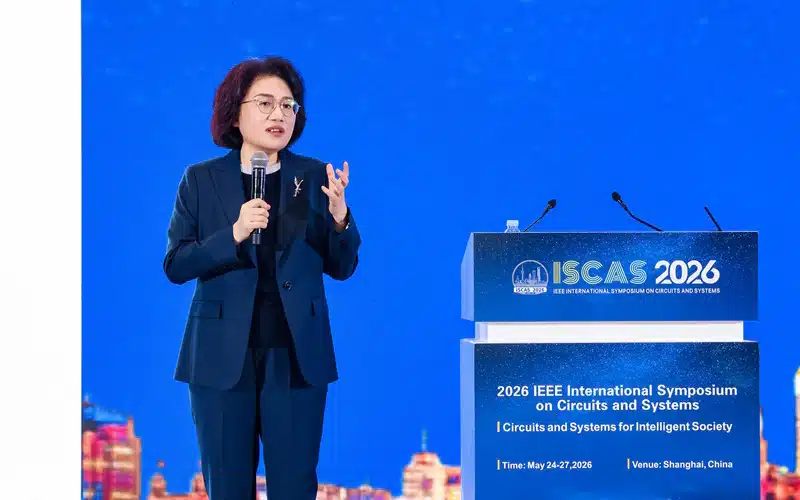
Huawei has introduced the Tau (τ) Scaling Law alongside a Logic Framework designed to improve efficiency in how artificial intelligence workloads are executed on modern semiconductor based compute systems. The approach focuses on optimizing reasoning efficiency, inference behavior, and resource utilization across AI accelerators used in datacenters and edge devices.
The framework targets large language and reasoning models running on GPUs, NPUs, and dedicated AI accelerators, where power consumption, memory bandwidth, and thermal constraints increasingly limit performance scaling. Instead of depending solely on larger compute clusters or higher transistor density, the method focuses on improving how efficiently existing silicon processes reasoning tasks.
The Logic Framework is designed to reduce redundant computation and improve structured reasoning efficiency during inference. This has direct relevance for AI accelerator architecture, where workload execution efficiency, memory access optimization, and compute scheduling determine overall system performance.
The development reflects a broader shift in semiconductor driven AI systems, where scaling limits are increasingly defined by energy efficiency and interconnect bottlenecks rather than raw compute capability. Improving reasoning efficiency at the model execution level can improve effective silicon utilization without requiring proportional hardware expansion.

This approach also aligns with emerging trends in AI hardware design, where system level optimization is becoming as important as transistor level improvements. Engineers are increasingly focusing on how AI workloads map onto accelerator pipelines and how compute cycles can be reduced during inference.
“We believe that openness and collaboration are key to driving ongoing progress in the semiconductor industry,” says He Tingbo, Director and Chair of the Huawei Scientist Committee and ITMT Director. “No single company can independently find all the answers along the path of semiconductor evolution. With the τ Scaling Law, we look forward to working closely with scientists, engineers, and industry partners around the world to drive the sustainable development of the semiconductor and electronics industries.”