




Researchers have developed autonomous floating robots that self-assemble into stable structures, offering a scalable approach for temporary infrastructure, emergency response and environmental monitoring.
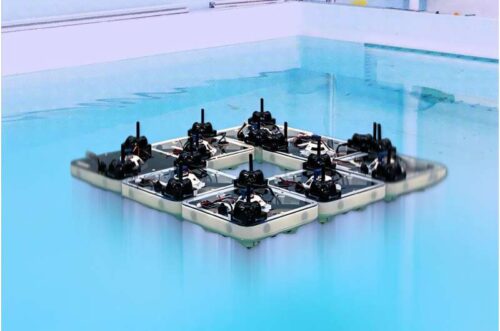
Massachusetts Institute of Technology (MIT) researchers have developed FloatForm, a swarm of autonomous aquatic robots that can assemble themselves into larger floating structures, separate on command and reconfigure into new formations with minimal human intervention. The system is designed to create adaptable infrastructure on water for applications including emergency response, environmental monitoring and temporary public spaces.
Each robot is a self-contained floating vessel measuring about 21sqcm and equipped with thrusters, sensors and magnetic latching mechanisms. Working collectively, the robots navigate independently before connecting to form stable platforms, bridges or other floating structures that can later break apart and reorganise as required.
Unlike conventional self-assembling robotic systems that rely heavily on a central controller, the new approach distributes most decision-making among individual robots. Each unit exchanges information only with nearby neighbours, allowing the swarm to move simultaneously while keeping planning complexity low as more robots are added. Laboratory tests demonstrated successful operation with eight robots, while simulations indicated the architecture could scale to swarms of 64 units.
The researchers drew inspiration from fire ants, which naturally form floating rafts during floods through simple local interactions rather than central coordination. Similarly, the robots follow local behavioural rules while a lightweight central planner intervenes only when precise positioning is required.

An energy-efficient magnetic latching system further improves performance. An origami-inspired mechanism locks or releases the magnets using power only during the latching and unlatching process, helping conserve battery life for movement and computation.
Across multiple indoor trials, the robots completed missions autonomously in most cases and recovered from several failures without halting the entire swarm. The team believes future versions could support floating inspection platforms, emergency bridges, temporary event spaces, environmental sensing networks and reconfigurable marine infrastructure in rivers, canals and sheltered coastal waters.


