





A robot uses a symmetrical design and 20 sensor-equipped legs to move across terrain, recover from damage, and navigate without a fixed front or back.
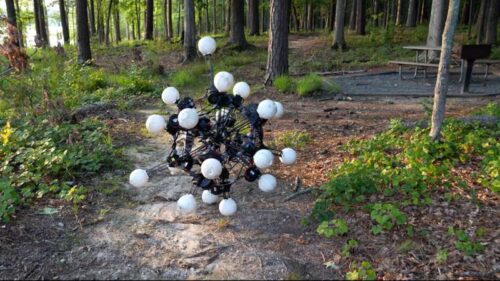
A team of roboticists at Duke University has developed a robot called Argus that can move, stabilize itself, and perceive its surroundings equally well in nearly every direction. The researchers say the machine challenges one of robotics’ assumptions: that robots need to resemble animals or humans to move effectively through the world.
Instead of legs arranged around a clear front and back, Argus is built around a spherical, sea-urchin-like structure with 20 telescoping legs extending from a core. Each leg is equipped with a depth camera, allowing the robot to maintain awareness of its surroundings while moving across terrain.
The robot has already demonstrated a range of capabilities in outdoor tests. According to the researchers, Argus can roll across concrete, grass, foliage, sand, wet surfaces, and tree bark regardless of orientation. It can recover after being pushed, continue operating even after losing multiple legs, carry a 10-pound payload at close to full speed, and climb between walls by bracing itself with alternating sets of limbs.
At the center of the project is a mathematical principle the Duke team calls “dynamic isotropy,” which measures how evenly a robot can accelerate its body in any direction. Robots are scored on a scale from 0 to 1. Most quadrupeds, humanoids, and drones score below 0.6, according to the researchers. Argus achieved a score of 0.91, approaching what the team describes as the limit.
The idea emerged from simulations rather than from copying biological systems. The researchers tested more than 1,500 robotic configurations and found that performance consistently improved as directional symmetry increased. Robots with higher scores were more stable, more energy efficient, more resilient to damage, and better at navigating terrain.
That design philosophy is visible throughout Argus. Its 20 camera-equipped legs are positioned at the vertices of a regular dodecahedron, a 12-faced geometric shape that distributes movement and perception across the robot’s body. The arrangement allows Argus to reorient instantly without needing to turn around in the way robots do.
The robot also adapts well to damage. In one test, it continued moving after three of its legs were disabled. In another, it tracked and pushed a three-foot cube while rolling across uneven ground.
For the researchers, Argus is less a finished product than a demonstration of an engineering framework. The team says dynamic isotropy could be used to compare robots or generate new designs optimized for harsh, cluttered, or low-gravity environments.

