


A new in-package cooling innovation tackles rising heat challenges in 3D-stacked memory chips, improving thermal efficiency and stability for AI workloads while enabling higher bandwidth and denser chip architectures.
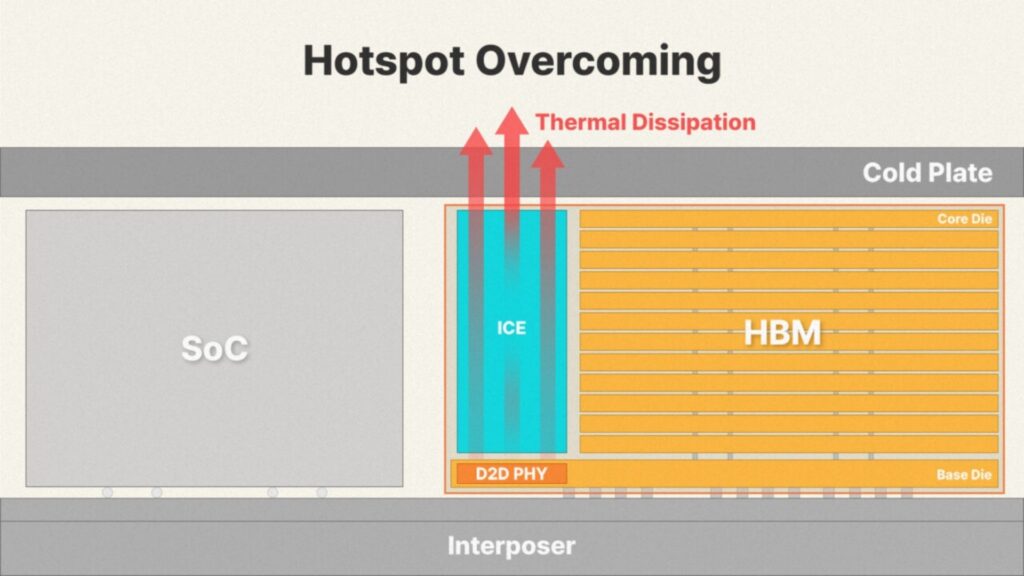
As AI workloads push memory systems to their performance limits, thermal management is emerging as a critical bottleneck in next-generation chip design. SK hynix has introduced a novel cooling architecture integrated directly inside its 3D-stacked high-bandwidth memory (HBM) chips, aiming to address heat generation at its most intense source within the package.

The solution, branded as iHBM, embeds Integrated Cooling Elements (ICEs) within the memory stack itself rather than relying on external heat dissipation pathways. These ICEs are made of electrically non-conductive but thermally conductive silicon-based material, creating an additional heat escape channel inside the chip package.
The key innovation targets the Die-to-Die Physical Layer (D2D PHY), the high-activity interface connecting stacked DRAM dies to AI processors such as GPUs. This region experiences extreme thermal density due to continuous high-speed data exchange, making it one of the hottest zones in advanced AI hardware.
By introducing localized cooling at this interface, the architecture reduces thermal resistance by about 30%, allowing chips to maintain stable performance under sustained high-bandwidth workloads. This directly addresses a major limitation in current HBM scaling, where increased stacking density and faster data rates intensify heat buildup.
The design is also compatible with existing wafer-level packaging and system-in-package processes, meaning it can be integrated into current manufacturing flows without major redesigns. This improves its scalability potential for next-generation memory products such as future HBM iterations aimed at AI data centers.
The development reflects a broader shift in semiconductor engineering where thermal design is becoming as critical as transistor scaling. As AI systems demand higher memory bandwidth and tighter integration between compute and memory layers, managing heat at the architectural level is increasingly essential for sustaining performance gains.
With iHBM, memory is no longer just a data storage layer but an actively engineered thermal and performance component, signaling a deeper convergence of packaging, materials science, and AI-driven compute demands in advanced semiconductor design.