




A vehicle USB Type C charging system that can deliver up to 140 W power while reducing component count and simplifying multi port designs. How?
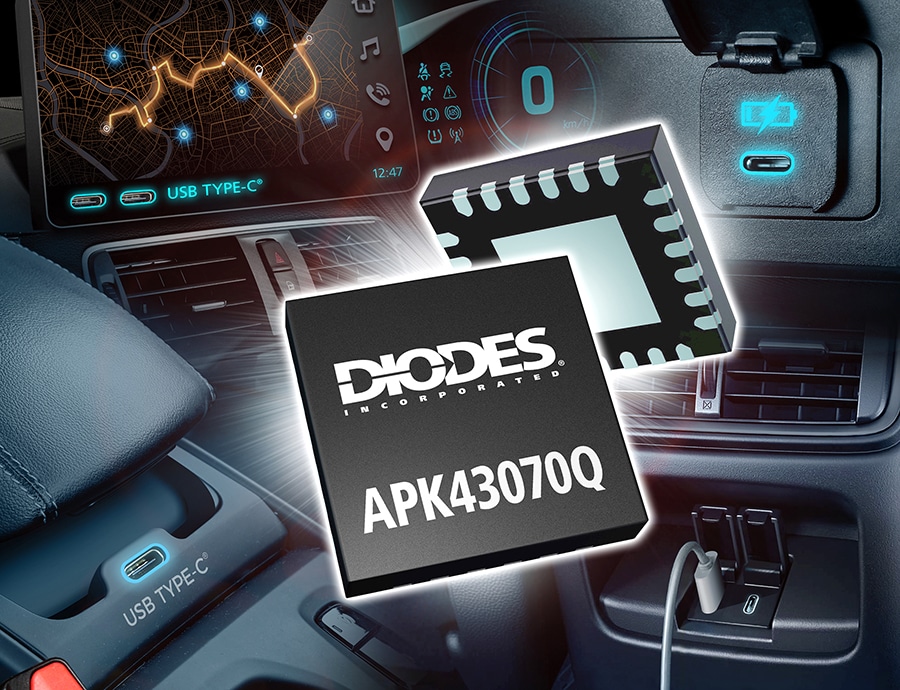
Diodes Incorporated has introduced the APK43070Q, an automotive compliant synchronous buck controller integrated with a USB Type C PD3.1 source controller for high power in vehicle charging applications.
Designed for single and multi port automotive charging modules, the device operates from a 4 V to 36 V input and supports USB PD3.1 extended power range and adjustable voltage supply modes up to 28 V. It also supports standard power range and programmable power supply modes up to 21 V, enabling USB Type C charging ports delivering up to 140 W.
The integrated synchronous step down controller supports external N channel MOSFETs, allowing designers to optimize thermal and power efficiency for mid to high power charging systems. The architecture also supports VIN DC power pass through operation, where the high side MOSFET functions as the VBUS switch, reducing the need for additional output switching components.
To simplify multi port charging systems, the device integrates an I2C interface supporting controller and target addressing across up to eight USB Type C ports without requiring an external microcontroller. This helps reduce system complexity and BOM cost in automotive charging platforms.
The controller also integrates protection features including overvoltage, overcurrent, undervoltage, overtemperature, and connector moisture detection. In addition, the CC1, CC2, and DP/DN pins are designed to tolerate short to VBUS fault conditions up to 30 V.
The device is also offered in a 4×4 mm W QFN package for automotive USB charging applications, while a standard compliance version for industrial and commercial systems is also available.
Click here for the official announcement.


