


A Hall-effect sensor combines three Hall elements to measure speed and direction in motors, supporting position sensing, anti-pinch control, and steering applications.
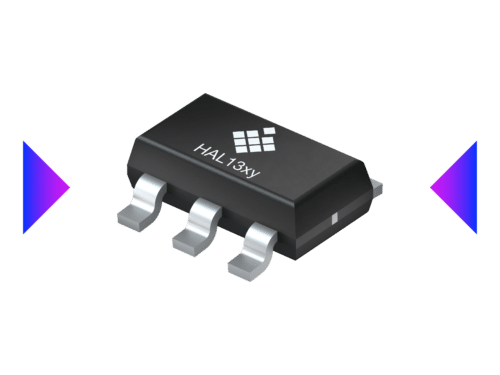
TDK Corporation has introduced the Micronas HAL 13xy family, a Hall-effect switch sensor designed for speed and direction detection in automotive and industrial systems. The device combines three orthogonal Hall elements in a single pixel cell to generate a quadrature signal with 90° phase separation, allowing the measurement of two magnetic-field components at the same time. The design reduces sensitivity to magnet pole spacing and air-gap variations, giving engineers more flexibility in motor and sensor placement.

The sensor targets motor-control and position-sensing applications where motion feedback is required. Planned automotive uses include seat-track motors, sunroof motors, tailgate motors, steering column motors, steering turn-count sensing, valve-position sensing, and window lifters with anti-pinch functionality.
In seat-track systems, the sensor can support position and direction detection for powered seat adjustment. In sunroof and tailgate motors, it can help manage opening and closing operations. For steering systems, the device can track rotational movement and steering position, while in window lifters it can support anti-pinch detection by monitoring motor movement.
HAL 13xy provides two independent open-drain outputs that can be configured for speed/speed or speed/direction signals. This allows the same device to support different motor-control architectures without additional sensing components.

The device is built to operate under automotive conditions, supporting junction temperatures from –40 °C to 170 °C and supply voltages from 3.0 V to 24 V. Protection features include 40 V load-dump capability, -18 V reverse-voltage protection, and short-circuit and thermal protection. The sensor is qualified to AEC-Q100 standards and is designed to meet ISO and IEC EMC requirements.
TDK has also integrated continuous built-in self-test (BIST) functions into the device. Developed as a Safety Element out of Context (SEooC), the sensor is ASIL B ready under ISO 26262, making it suitable for safety-related automotive systems.
The HAL 13xy family supports static and dynamic magnetic fields up to 40 kHz and can operate with both ferrite and rare-earth magnets through different temperature coefficient options. The sensor comes in a 5-pin SOT23 package with ESD protection up to 4 kV HBM.
Click here for the original announcement.