




A new GNSS-disciplined oscillator combines dual-frequency satellite reception, AI-assisted timing correction and microsecond-class holdover in a postage-stamp-sized package designed for space- and power-constrained systems.
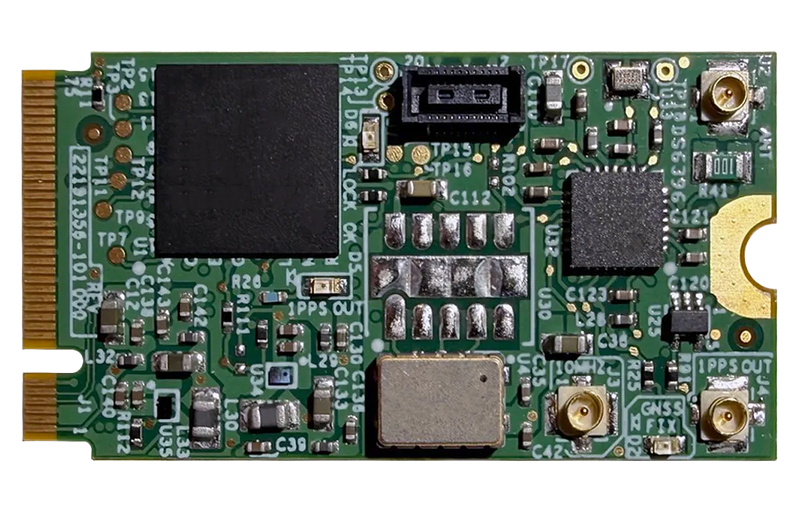
Precision timing technology is becoming increasingly critical for defence systems, autonomous platforms and communications infrastructure, as operators seek resilient alternatives amid rising risks of GNSS disruption. Addressing this demand, VIAVI Solutions Inc. has introduced a new ultra-compact GNSS-disciplined oscillator in an M.2 B-key form factor, delivering high-accuracy timing in environments where traditional timing modules are often too large or consume excessive power.
The key features are:
- Dual-frequency L1/L5 GNSS reception for resilient timing
- Microsecond-class 24-hour holdover capability
- Postage-stamp-sized M.2 B-key form factor
- AI/ML-based oscillator prediction and compensation
- MEMS oscillator with low power consumption and military-grade stability
The device measures 22 mm x 42 mm—roughly the size of a postage stamp—and weighs less than four grams. Designed for integration into embedded computing platforms, airborne systems, unmanned vehicles, communications equipment and data-centre hardware, it aims to provide precision timing while minimising size, weight and power requirements.
One of its key capabilities is dual-frequency L1/L5 GNSS reception, a feature increasingly specified in defense and critical infrastructure projects to improve resilience against interference and signal degradation. The module also delivers microsecond-class holdover performance for up to 24 hours, allowing systems to maintain accurate timing even when satellite signals become unavailable.
The timing solution uses a MEMS-based oscillator rather than conventional quartz OCXO technology. According to the developer, this approach improves thermal stability across military operating temperatures while maintaining performance under vibration and shock conditions. The module consumes approximately half a watt, making it suitable for platforms with strict power budgets.
Artificial intelligence and machine learning algorithms are incorporated to predict and compensate for oscillator behavior under changing environmental conditions. This helps sustain timing accuracy during challenging operating scenarios and extended GNSS outages.
The module also supports an external 1PPS input, enabling synchronization from alternative navigation sources, M-Code GPS systems or other external references without requiring hardware modifications. Multiple 1PPS and low-phase-noise 10 MHz input and output interfaces are included to simplify integration into broader timing architectures.
The launch comes as organizations across defense, aerospace and critical infrastructure sectors seek alternatives to chip-scale atomic clocks, which can face higher costs and supply-chain constraints, while avoiding the size and power demands of traditional OCXO-based timing systems.


