





A handheld device scans objects in 3D using AI. It connects to phones and creates digital models. It can be used in different locations.
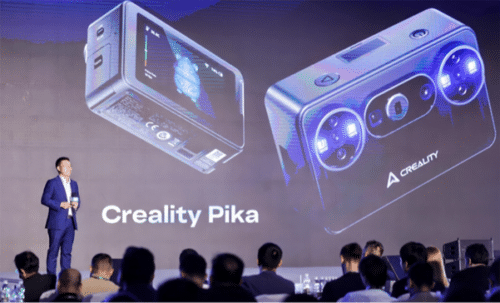
Creality has launched Pika, a compact AI-powered portable 3D scanner co-developed with Orbbec. The device combines laser and infrared 3D scanning with on-device AI processing and is designed for mobile use without a PC. It supports up to 110 FPS scanning in PC mode and offers 0.03 mm accuracy in high-precision mode.
Pika is built for handheld and field scanning. It measures 100 × 60 × 35 mm and weighs about 260 g, making it pocket-sized. It includes a built-in HD preview screen and a replaceable battery, allowing continuous mobile scanning. It can connect directly to a smartphone for standalone operation, which removes the need for traditional workstation setups.
The scanner uses a dual-system approach: a 7-line blue laser for fine-detail capture and infrared structured light for larger objects and human-body scanning. The blue laser mode is designed for high-precision tasks like mechanical parts and small objects, while infrared mode supports marker-free scanning of people and larger scenes.
The system reaches up to 40 FPS in smartphone laser mode, 20 FPS in infrared mode, and up to 110 FPS when connected to a PC. A global shutter camera architecture helps reduce motion blur and improves tracking stability during movement.
AI is used in scan processing and reconstruction. It improves tracking stability and helps generate usable 3D models with less manual cleanup. The software also includes an AI body completion feature that fills missing geometry in human scans to produce printable models.
The launch comes as Creality and Orbbec expand their partnership. The companies announced a joint “3D Scanner Digital Innovation Center” and a “3D Printing AI Vision Platform” aimed at combining scanning hardware with AI-based manufacturing workflows.
Both companies have been working together since 2023 on 3D scanning and digital manufacturing tools. Orbbec continues to supply core vision and sensing technology, while Creality focuses on consumer 3D printing ecosystems. The collaboration is aimed at making 3D capture and printing more accessible for creators, engineers, and small manufacturers.
Click here for the original announcement.


