




What if the sensation from your feet could be rerouted to another part of your body? A wearable system uses heat and vibration to help people regain balance and improve walking.
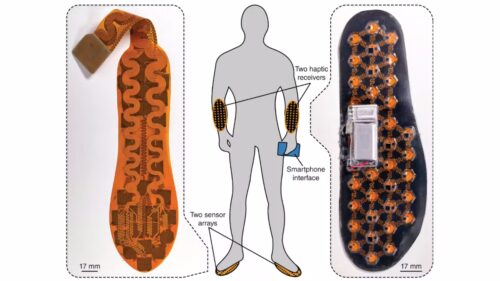
Researchers at Georgia Institute of Technology have developed a wearable system that helps people with sensory impairments regain awareness of how their feet contact the ground. The technology uses pressure-sensing insoles and forearm-mounted haptic devices to provide real-time feedback, improving balance and walking performance in trials involving individuals with stroke and spinal cord injuries.

The system works by placing pressure-sensing insoles inside a user’s shoes to monitor weight distribution across the feet. The data is transmitted wirelessly via Bluetooth to devices worn on the forearms. Instead of sensing pressure through their feet, users receive patterns of vibration and heat on their arms that reflect what is happening beneath them.
According to the researchers, the technology uses a sensory-substitution approach. Rather than restoring damaged nerves, it redirects sensory information to another part of the body that still has sensation. The forearms were chosen because many people with spinal cord injuries retain sensitivity in this area even when sensation in their feet has been lost.
The forearm-mounted arrays contain 64 individually controlled nodes that can generate both thermal and vibrotactile feedback. Together, they provide 128 degrees of freedom, allowing information to be communicated through the skin. A hybrid actuator enables independent control of heat and vibration at each node.
In testing, participants learned to interpret the haptic signals after approximately two hours of training. Studies showed that the additional sensory feedback led to improvements in standing balance and walking ability.
The researchers also see healthcare applications beyond mobility assistance. While vibration can provide feedback for walking and balance, thermal signals could serve as warnings of prolonged pressure on specific areas of the foot. This may help prevent foot ulcers in people with diabetes and reduce the risk of pressure injuries in wheelchair users.
Loss of sensation in the feet can make activities such as standing and walking difficult because the body no longer receives information about ground contact and weight distribution. To address this challenge, the research team designed a lightweight, wireless, and untethered system that can be used outside laboratory settings. Future work will focus on miniaturising the hardware and adapting it to the needs of different users.


