






What if scientists could simply describe an experiment and let AI handle the rest? A new agentic system translates ideas into robot-ready instructions.
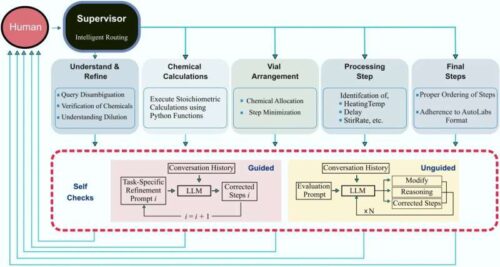
Researchers at the Pacific Northwest National Laboratory (PNNL) have developed AutoLabs, an agentic AI system that translates scientists’ natural-language experimental goals into detailed instructions for autonomous laboratory robots. The technology aims to reduce the time and expertise required to programme robotic experiments, allowing researchers to focus on scientific discovery rather than robot operation.
AutoLabs is designed to work with Big Kahuna, an automated laboratory robot used for battery materials research. Instead of requiring scientists to manually translate an experiment into machine-specific commands, the AI interprets natural language instructions and generates the sequence of actions needed for the robot to perform tasks such as mixing chemicals, heating, stirring, filtering and transferring samples.
The system uses multiple specialised AI agents coordinated by a supervisory agent. Individual agents handle tasks such as understanding user requests, performing chemical calculations, arranging sample vials, defining processing steps and validating the final workflow. This multi-agent approach enables the system to refine instructions and correct potential errors before execution.
Researchers evaluated AutoLabs using experiments of increasing complexity, ranging from simple chemical mixtures to multi-step procedures involving several chemicals, temperature control, stirring speeds and repeated sample transfers. In every test, the AI successfully translated the experimental descriptions into executable robot instructions, demonstrating performance comparable to that of trained laboratory users.
According to the research team, AutoLabs can enable laboratories to perform five to ten times more experiments than would be practical using conventional manual workflows. The developers emphasise that the system is intended to assist scientists rather than replace them by automating repetitive planning and robot programming tasks while keeping researchers in control of experimental design.
The team plans to expand AutoLabs with long-term memory and literature review capabilities, enabling it to support a broader range of autonomous laboratory platforms and increasingly complex scientific workflows in the future.
