The chip combines high-performance biosignal acquisition with ultra-low power consumption, paving the way for next-generation wearable electronics and long-term health monitoring.
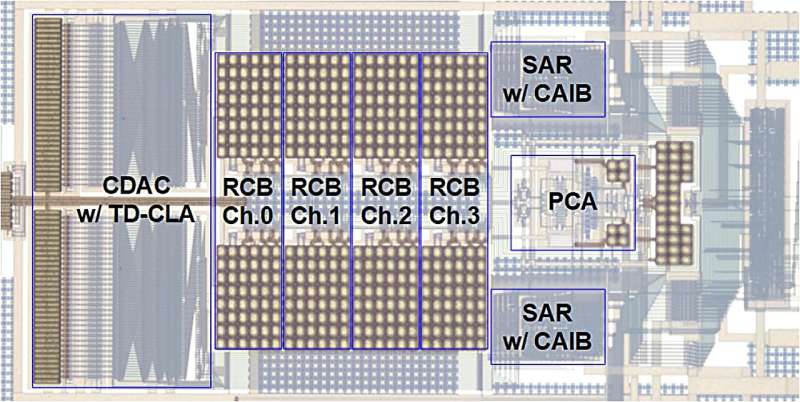
Researchers at Daegu Gyeongbuk Institute of Science and Technology have developed what is being described as the world’s first ultra-compact semiconductor chip designed for high-precision biosignal measurement, marking a significant advance in wearable electronics. The new integrated circuit combines ultra-low power consumption, compact size and high measurement accuracy, addressing key limitations that have restricted the development of long-term health monitoring devices. The technology is expected to accelerate next-generation digital healthcare platforms capable of continuously measuring physiological signals outside clinical settings.
The chip was designed around a novel time-interleaved third-order noise-shaping successive approximation register analog-to-digital converter (SAR ADC) architecture. Instead of dedicating complete circuitry to every sensing channel, the researchers shared high-power and large-area circuit blocks across multiple channels while allocating only essential residual capacitor banks separately. This architecture significantly reduces silicon area and power consumption without compromising signal quality, making it particularly suitable for compact wearable electronics where battery life and device size are critical design constraints.
To further improve efficiency, the team incorporated proprietary circuit techniques, including Capacitor Area and Initial Voltage Biasing (CAIB), which lowers power consumption by presetting voltage levels before signal conversion, and Time-Domain Calibration Logic Architecture (TD-CLA), which compensates for signal distortion introduced during measurement. Together, these technologies enable the chip to deliver stable, high-fidelity biosignal acquisition while maintaining extremely low energy consumption, even under changing operating conditions encountered in wearable applications.
One of the major engineering challenges for wearable biosensors is maintaining accurate measurements despite body movement, varying skin contact and changes in electrode conditions. According to the researchers, the new semiconductor architecture is capable of sustaining reliable performance under these dynamic conditions, making it suitable for wearable devices that employ dry or non-contact electrodes. This expands its potential beyond conventional medical monitoring systems and reduces dependence on gel-based sensing technologies commonly used in clinical environments.
The semiconductor chip is expected to support a broad range of electronics applications, including continuous health monitoring, next-generation wearable medical devices and precision diagnostic equipment. By integrating multiple performance requirements into a single ultra-compact integrated circuit, the technology provides a foundation for future wearable electronics capable of long-duration biosignal monitoring while consuming minimal power. Researchers believe the design could play a key role in advancing digital healthcare systems that require compact, energy-efficient and highly reliable semiconductor solutions.